Beaconstac to Uniqode (2026): What Changed, Why Users Left
Beaconstac rebranded to Uniqode in 2023. Pricing jumped, features shifted, and users started leaving. Here's what actually changed.
This article was written by the QR Nova team. We build QR code software, which may inform our perspective.
Beaconstac became Uniqode in May 2023. If you searched for your QR dashboard one morning and landed on a completely different-looking website, you weren't hacked, you were rebranded. The name changed. The pricing changed. And judging by the volume of people searching "beaconstac to uniqode," a lot of users are still confused about what exactly happened to the platform they signed up for.
Short version: Beaconstac and Uniqode are the same company, same product, same infrastructure. But the rebrand came with pricing restructuring, feature tier shuffles, and enough friction that a meaningful number of users started looking for alternatives.
TL;DR
- Beaconstac rebranded to Uniqode in May 2023. Same team, same product, different packaging.
- Pricing restructured: annual-only billing on QR plans, scan caps on every tier under $399/mo, 60-day analytics on cheapest plan.
- Custom domains now cost $2,000/year as an add-on (free only on $399/mo Business+).
- Existing QR codes still work, but some features moved to higher tiers after the rebrand.
- Users leaving cite lock-in, scan caps, and pricing opacity as main reasons.
Why Beaconstac became Uniqode: the Beaconstac to Uniqode story
See pricing — start free today
Get startedBeaconstac started in 2013 as a Bluetooth beacon company. The product was physical hardware, small transmitters that pushed notifications to nearby phones. Proximity marketing was the pitch. QR codes were a side feature, added around 2018 when beacon adoption stalled and QR usage started climbing.
By 2022, QR codes were driving most of Beaconstac's revenue. The "beacon" in the name was actively confusing new customers searching for QR solutions. The rebrand to Uniqode, a portmanteau of "unique" and "code", repositioned the company as QR-first.
The timing made sense. COVID had pushed QR adoption mainstream. Restaurant menus, contactless payments, vaccine passports, suddenly everyone knew what a QR code was. A company named after Bluetooth beacons was leaving money on the table in search rankings and paid ads. Call it a delayed evolution. The product had already moved on; the name just caught up.
What actually changed in the rebrand
The infrastructure didn't change. Your old Beaconstac QR codes still resolve through the same redirect servers, now running under the Uniqode domain. The dashboard URL changed from app.beaconstac.com to app.uniqode.com. Your login credentials carried over.
What changed was the commercial layer on top:
Pricing restructured
Uniqode's current pricing as of April 2026:
- Free: Static QR codes only. Zero dynamic codes. Functional for one-off static needs, but the moment you need a redirect or analytics, you're paying.
- Starter ($15/mo, annual only): 50 dynamic codes, scan limits that vary by plan tier, 60-day analytics retention. No monthly billing option, you commit for 12 months upfront.
- Core and Plus tiers: Higher scan caps, longer analytics retention (90 and 180 days respectively), more codes. Still annual-only.
- Business+ ($399/mo): The only tier with unlimited scans, custom domains included, and SOC 2 compliance documentation.
Feature tier shuffles
Features that were accessible on mid-tier Beaconstac plans migrated to higher Uniqode tiers. The two that users mention most:
- Custom domains: Under Beaconstac, custom short domains were available on lower plans. Under Uniqode, they're a $2,000/year add-on unless you're on Business+ at $399/month. For a team that relies on branded short URLs in print materials, that's $2,000 per year just to keep your own domain.
- Analytics retention: 60 days on Starter means your scan data from January disappears in March. If you're running campaigns longer than two months and need to compare performance, you either upgrade or export manually before the window closes.
Scan caps
Every Uniqode plan below Business+ has scan limits. Hit the cap, and your codes stop working mid-campaign. Not "stop tracking." Stop working, scans return an error page. For a QR code on printed packaging that's already in stores, that's a disaster you can't fix without waiting for the next billing cycle or upgrading immediately.
Why users are leaving
Search volume for "uniqode alternative" and "beaconstac alternative" has been climbing since late 2023. The complaints aren't random, they cluster around four specific problems:
1. annual billing lock-in
No monthly billing on QR plans. You either commit for a year or you don't use Uniqode's dynamic features. For a team testing QR codes for a specific campaign or seasonal business, a 12-month commitment to find out if the platform works is a hard sell. Most competitors, QR Tiger, Flowcode, QR Nova, offer monthly billing. Uniqode is the outlier here, not the norm.
2. scan caps that kill live codes
Scan caps aren't unique to Uniqode. QR Tiger caps at 500 scans on free dynamic codes. Flowcode caps at 500. But Uniqode's caps apply to paid plans too, all the way up to their second-highest tier. The $399/month Business+ is the only plan where scans are truly unlimited. That's a steep threshold for something most platforms treat as a basic paid feature.
The real problem isn't the cap. It's what happens when you hit it. Codes stop resolving. No grace period, no warning scan, no "you've exceeded your limit, upgrade to continue." The code just dies.
Think of it like a highway tollbooth that locks the gate when you run out of tokens, not when you exit, but while you're mid-drive. For a QR code on a product label sitting on a retail shelf, that's a failure you can't fix remotely.
3. pricing opacity
Uniqode's pricing page doesn't make scan caps easy to find. You need to dig into plan details or contact sales to understand exactly what your cap is and what happens when you exceed it. Several reviews on G2 and Capterra mention being surprised by caps they didn't know existed until codes stopped working. That's not a misunderstanding, that's a design choice.
4. the rebrand itself caused confusion
Rebrands break muscle memory. Bookmarks stop working. Saved logins fail because the domain changed. Team members who weren't tracking the transition showed up to a dashboard that looked different, with a URL they didn't recognize.
For larger organizations with multiple people managing QR campaigns, this was enough of a disruption that some teams used the moment to evaluate alternatives. Not because Uniqode did something wrong, rebrands happen, but because the chaos created a natural evaluation window that didn't exist before.
What stayed good about Uniqode
To be direct: Uniqode is a genuinely good product for the right buyer. If your organization needs a real audit trail, it's one of the few QR platforms that can deliver it.
- Enterprise compliance: SOC 2 Type II certification, GDPR compliance, and HIPAA-ready infrastructure. If your organization requires compliance documentation for vendor approval, Uniqode is one of the few QR platforms that can provide it.
- Bulk operations: The API and bulk creation tools are solid for teams generating hundreds or thousands of codes programmatically.
- Analytics depth: When you have access (and the retention window hasn't expired), Uniqode's scan analytics are detailed, device types, locations, time patterns, unique vs. repeat scans.
- Template library: The QR code designer has a wide range of templates and customization options, including logo embedding and color gradients.
The issue isn't quality. It's the commercial structure around that quality, caps, retention limits, annual lock-in. A good product with hostile pricing terms still creates churn. Uniqode is proof of that.
What to check before you switch away from Uniqode
If you're on Uniqode and thinking about migrating, here's what to verify before you move:
Export your data first
Uniqode allows CSV export of QR code data and scan analytics on paid plans. Do this before you cancel. Once your subscription ends, you lose dashboard access. Export: code URLs, destination URLs, creation dates, scan counts, and any analytics you need for reporting. Do it while you still can.
Understand what happens to your codes
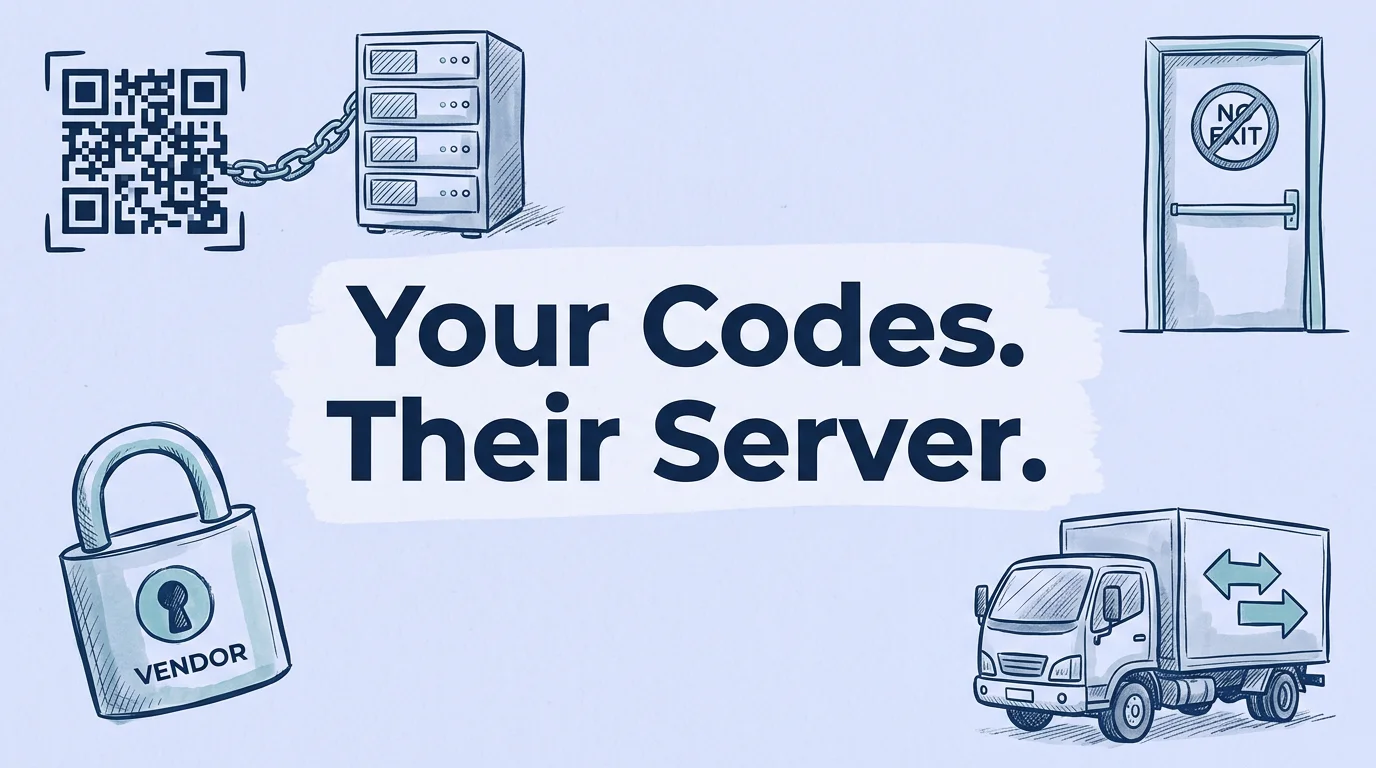
Dynamic QR codes created on Uniqode use Uniqode's redirect servers. When you cancel, those redirects stop. Every printed material with a Uniqode dynamic code will point to a dead link. Static codes are fine, the URL is in the image itself, no server involved.
If you have QR codes on printed materials that are still in circulation, you have two options: keep paying Uniqode to maintain those specific redirects, or accept that those codes will die. There's no way to transfer a dynamic QR code between platforms because the redirect URL is baked into the printed image. It's already out in the world.
Check your scan limits before the switch
If you're close to your scan cap, switching platforms won't restore the codes that have already hit their limit on Uniqode. Those codes are printed with Uniqode's redirect URLs, they'll always depend on Uniqode's servers regardless of where you move your account.
Alternatives worth evaluating if you're leaving Uniqode
If you're moving away from Uniqode, here's what to compare on:
| Feature | Uniqode | QR Nova | QR Tiger |
|---|---|---|---|
| Monthly billing | No (annual only) | Yes | Yes |
| Scan limits (paid) | Capped on all plans under $399/mo | None on paid plans | Varies by tier |
| Codes after cancel | Deactivated | Stay active | Deactivated |
| Custom domain | $2,000/yr add-on | From $29/mo plan | From $49/mo plan |
| Analytics retention | 60-180 days by tier | Full history | Full history |
| SOC 2 compliance | Yes ($399/mo tier) | No | No |
| Starting price (dynamic) | $15/mo (annual) | $9/mo (monthly) | $7/mo (annual) |
For the detailed feature comparison, see QR Nova vs Uniqode.
If your main concerns are scan caps and annual lock-in, QR Nova solves both, monthly billing from $9/month, no scan limits on any paid plan, and codes that stay active if you cancel. The honest trade-off: you lose SOC 2 and Uniqode's enterprise compliance stack. If your IT department requires a vendor security questionnaire with certification docs attached, Uniqode may be your only real option in this category. For everyone else, it's worth running the numbers on whether $399/month in Uniqode Business+ features is actually what you need, or just what you've been sold.
The bigger lesson from the Beaconstac to Uniqode rebrand
The Beaconstac-to-Uniqode story is a case study in what happens when a platform changes terms on users who are already locked in with printed QR codes. You can't switch QR platforms the way you switch email providers. Your codes are physically printed on materials in the real world. The cost of switching isn't just the new subscription. It's every printed code that dies when you leave.
This is why vendor lock-in is the most important factor to evaluate before you choose a QR platform. Not features. Not pricing. Lock-in first. Because pricing and features change, Uniqode is proof, and when they change, your only leverage is the ability to leave. If leaving means killing every QR code on your printed materials, you don't have leverage. You're stuck.
Before committing to any QR platform for print, ask one question: what happens to my codes if I cancel? If the answer is "they stop working," factor the full cost of that dependency into your decision, not just the monthly rate, but the reprinting cost multiplied by every piece of material in circulation. That number is usually much larger than the subscription savings you were comparing.
Frequently asked questions
Is Beaconstac the same as Uniqode?
Yes. Beaconstac rebranded to Uniqode in May 2023. The product, team, and infrastructure are the same. Existing Beaconstac accounts carried over to Uniqode, but pricing plans and feature tiers changed during and after the rebrand.
Why did Beaconstac change its name to Uniqode?
Beaconstac originally built Bluetooth beacon hardware for proximity marketing. When QR codes became their main revenue driver, the 'beacon' name no longer fit. Uniqode positions the company as a QR-first platform. The rebrand happened in May 2023.
Did Uniqode change pricing after the rebrand?
Yes. Uniqode's current pricing starts at $5/month for static-only codes (no dynamic). Dynamic QR codes require the Starter plan at $15/month (annual billing only). The previous Beaconstac pricing was structured differently with lower entry points for dynamic codes.
Can I still use my old Beaconstac QR codes?
Existing QR codes created on Beaconstac still work, the redirect infrastructure carried over to Uniqode. However, your dashboard URL changed to uniqode.com, and some features migrated to different tier levels, so you may need a higher plan to access features you previously had.
What are the main complaints about Uniqode after the rebrand?
Common complaints include: annual-only billing on QR plans (no monthly option), scan caps that deactivate codes when exceeded, 60-day analytics retention on the cheapest plan, custom domains costing $2,000/year as an add-on, and SOC 2 compliance locked behind the $399/month enterprise tier.
What are good alternatives to Uniqode?
For teams that want QR code management without annual lock-in or scan caps: QR Nova offers monthly billing from $9/month with no scan limits on paid plans. QR Tiger and Flowcode are other options, though both have their own scan restrictions on lower tiers.
Does Uniqode deactivate QR codes if I cancel?
Yes. Dynamic QR codes on Uniqode stop working when your subscription ends. This is standard for most QR platforms, the redirect server requires an active subscription. Static codes continue working since the URL is in the image itself.
Related articles
QR Code Vendor Lock-In: What It Costs You
QR code vendor lock-in traps your printed materials behind subscriptions. Learn how it works, what it costs, and how to escape it, or avoid it entirely.
Free QR Code Generator With Unlimited Scans
Most free QR codes stop redirecting after 500 scans. QR Nova static codes have no scan cap and never expire — free, no sign-up, no credit card.
Do QR Tiger Codes Expire? What Happens When You Cancel
Do QR Tiger codes expire? Free codes die at 500 scans, paid codes deactivate when you cancel. Which codes survive, and how to avoid the trap.
See pricing — start free today
Get started