QR Code HIPAA Compliance: Complete Healthcare Guide
QR code HIPAA compliance in healthcare: when QR codes handle PHI, BAA requirements, which platforms comply, and a practical checklist for covered entities.
This article was written by the QR Nova team. We build QR code software, which may inform our perspective.
TL;DR
- HIPAA applies to QR codes when the code contains PHI or the QR platform processes PHI on behalf of a covered entity.
- Patient wristband QR codes encoding MRNs, medication label QR codes, and discharge instruction QR codes with patient portal links all involve PHI.
- Any QR platform used in a PHI context must sign a BAA — most consumer platforms (QR Tiger, Bitly, Flowcode) do not offer BAAs.
- Dynamic QR code analytics can create PHI when scan events are correlated with patient identity — the same logic that produced the hospital pixel tracking enforcement wave.
- Minimum required safeguards: BAA, encryption in transit and at rest, audit logs with 6-year retention, access controls, breach notification procedures.
- Static QR codes encoding public information (wayfinding, general hospital websites) do not trigger HIPAA obligations on the QR layer.
What Is PHI, and When Does a QR Code Contain It?
Create your first QR code — free
Get started- Names — patient name encoded in or accessible through the QR code
- Dates — dates of service, admission, discharge, or birth (year alone is permitted; full dates are identifiers)
- Geographic data — anything smaller than state level, including ZIP codes in some contexts
- Telephone and fax numbers
- Email addresses
- Social Security numbers
- Medical record numbers (MRNs) — one of the most common data elements in healthcare QR deployments
- Health plan beneficiary numbers
- Account numbers
- Device identifiers and serial numbers — relevant for medical device tracking QR codes
- URLs — a patient portal URL that includes a patient identifier in the query string is PHI
- IP addresses — in combination with health context, OCR has treated IP addresses as part of PHI
Healthcare QR Code Use Cases and HIPAA Exposure by Type
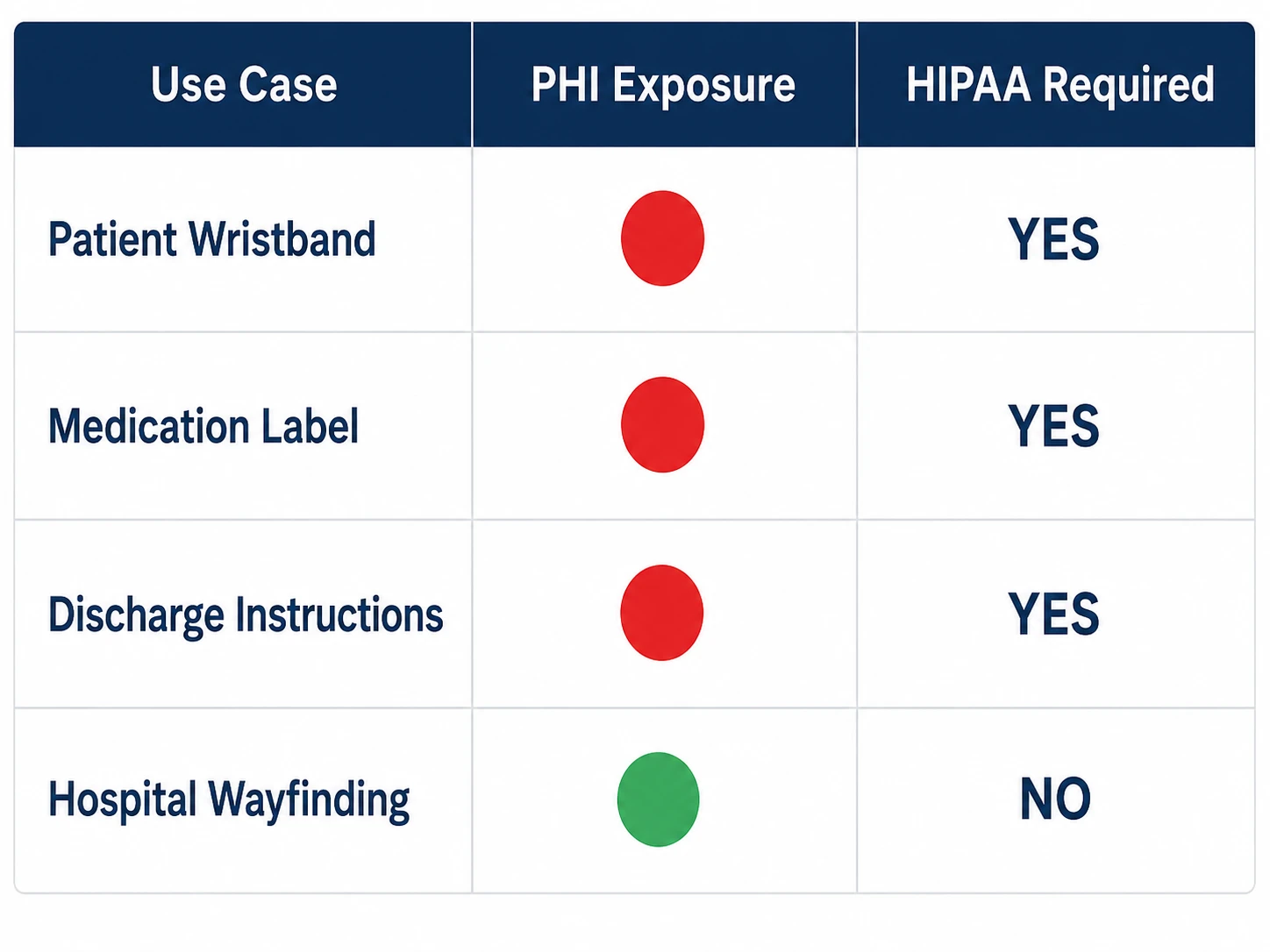 QR codes in healthcare span a wide range of applications. HIPAA exposure varies significantly by use case.
High PHI Exposure — Full HIPAA Compliance Required
Patient wristbands: QR codes on patient wristbands typically encode the medical record number, sometimes the patient name and date of birth, and a reference to the encounter. Every element is a HIPAA identifier. The generation system, printing system, and any scanning application must all operate under BAAs. Staff scanning devices must have access controls and audit logging. Medication labels: Pharmacy QR codes encode prescription data — drug name, dose, patient name, prescriber, dispensing date. This is PHI at every layer. EHR-integrated pharmacy systems generally manage this correctly, but third-party label printing vendors frequently do not have BAAs in place. Discharge instruction packets: QR codes printed on discharge papers that link to a patient's individual care plan, follow-up portal, or medication list are linking the scan event to that patient's health information. If the URL contains a patient identifier (common in patient portal deep links), the URL itself is PHI. The QR platform generating and tracking those codes must have a BAA. Appointment check-in kiosks: Kiosks that generate a QR code for a patient to scan, triggering check-in to their specific appointment, are processing PHI. The QR platform embedded in the kiosk is a Business Associate. Telehealth session links with patient parameters: A QR code linking to `telehealth.system.com/join?patient_id=123456&appt=789` contains a patient identifier and an appointment reference — PHI. If a third-party QR platform shortened or tracked that URL, it processed PHI without almost certainly having a BAA.Medium Exposure — Context-Dependent
Insurance card QR codes: Insurance cards with QR codes encoding member ID and group number are common. Member ID is a HIPAA identifier (#9 on the Safe Harbor list). Whether HIPAA applies depends on whether the card is issued by a covered health plan — if yes, the QR system falls under HIPAA regardless of whether the encoding platform is aware of this. Medical device tracking: QR codes on devices tracking serial numbers and maintenance records become PHI if those records are associated with specific patients (e.g., an implanted device record linked to patient identity). If device tracking is purely inventory-level with no patient linkage, HIPAA generally does not apply at the QR layer.No PHI Exposure — No HIPAA Obligation on the QR Layer
Wayfinding and directories: QR codes in hospital lobbies linking to floor maps or department directories contain no patient data and create no HIPAA obligation, regardless of the QR platform used. General public health information: QR codes linking to public health guidelines, vaccination information pages, or general hospital information constitute no PHI processing. Staff contact and scheduling (without patient data): QR codes for internal staff directories or general shift scheduling tools not linked to patient records do not trigger HIPAA compliance requirements.The Business Associate Agreement Requirement
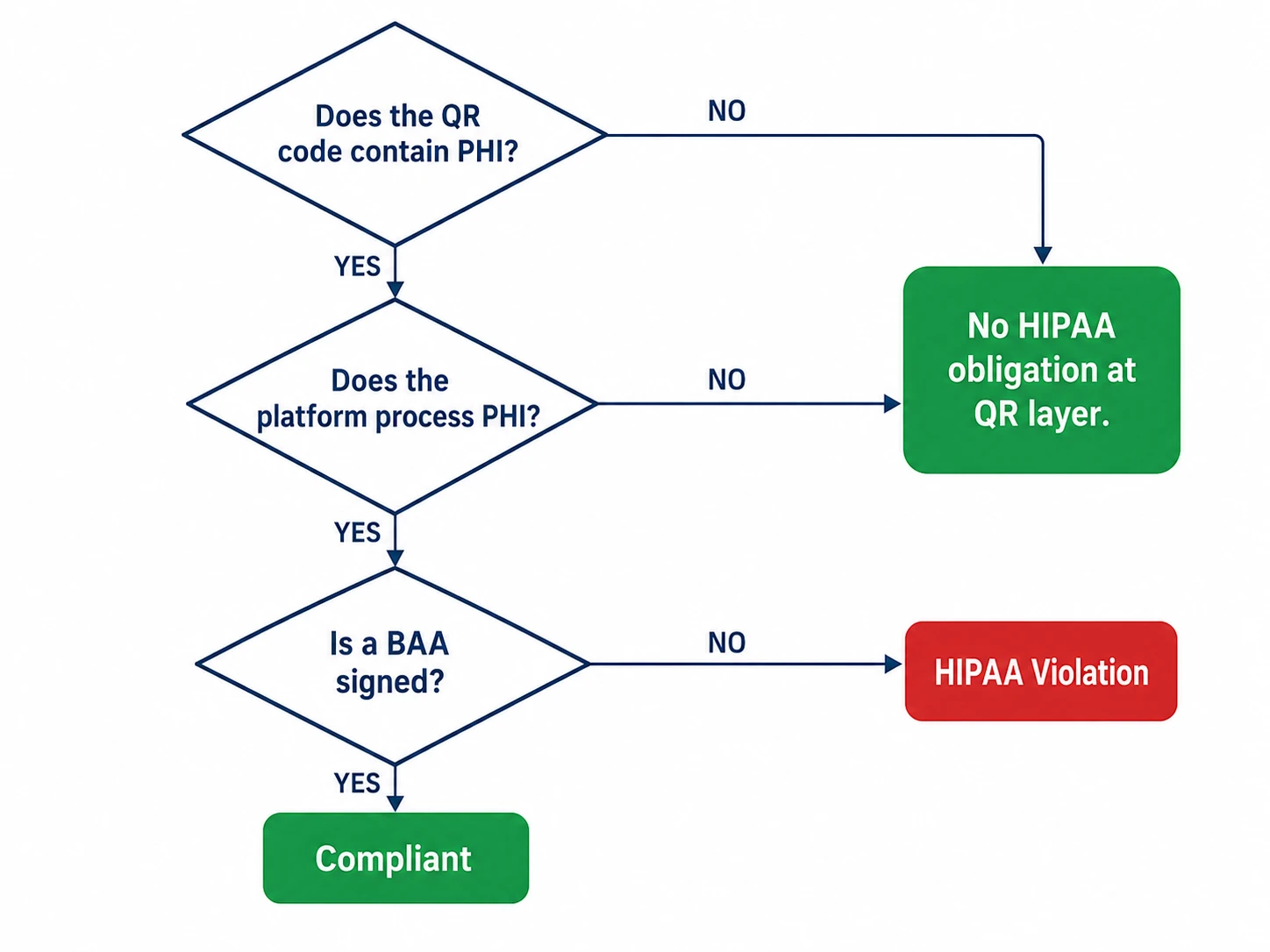 Under 45 CFR §164.308(b)(1), covered entities must obtain satisfactory assurances from Business Associates that they will appropriately safeguard PHI. Those assurances must be in writing — that is the BAA.
A Business Associate is any entity that:
Under 45 CFR §164.308(b)(1), covered entities must obtain satisfactory assurances from Business Associates that they will appropriately safeguard PHI. Those assurances must be in writing — that is the BAA.
A Business Associate is any entity that:
- Creates, receives, maintains, or transmits PHI on behalf of a covered entity
- Performs functions or activities on behalf of the covered entity that involve PHI
What Consumer QR Platforms Actually Offer
Most widely used QR platforms are not designed for healthcare use and do not offer BAAs:- QR Tiger — no BAA offering as of 2026; terms of service explicitly prohibit using the platform for HIPAA-covered data
- Bitly — enterprise plans offer a Data Processing Agreement, but Bitly does not position itself as a HIPAA Business Associate; no standard BAA available
- Flowcode — no BAA offering; consumer and marketing focus
- Beaconstac (now Uniqode) — enterprise plans offer security controls, but HIPAA BAA is not standard and requires direct negotiation
- QR Code Generator (Bitly-owned) — no BAA
- EHR-integrated QR functionality (Epic, Cerner, Oracle Health all include QR capabilities within their BAA-covered ecosystem)
- Enterprise document management platforms with existing healthcare BAAs
- Custom-built QR systems where the organization controls all infrastructure and vendors sign individual BAAs
- Healthcare-specific vendors who explicitly offer HIPAA BAAs and have SOC 2 Type II certification
Technical Safeguards Under the HIPAA Security Rule
The Security Rule (45 CFR Part 164, Subpart C) requires covered entities and business associates to implement administrative, physical, and technical safeguards for electronic PHI. For QR code systems handling ePHI, the relevant technical safeguards are:Access Controls (§164.312(a)(1))
Only authorized personnel should be able to generate QR codes containing PHI, and scanning PHI-containing codes should require authentication. A QR code on a patient wristband that can be scanned by any consumer QR app — revealing the MRN in plaintext — does not meet this requirement without additional system-level controls (e.g., the scan opens an authenticated session rather than revealing raw PHI).Audit Controls (§164.312(b))
Hardware and software activity that involves PHI must be logged. For QR systems, this means: who generated which code, when each code was scanned, on which device, and by which authenticated user. Logs must be retained for a minimum of six years — HIPAA's documentation retention standard under §164.530(j). Consumer QR analytics platforms typically provide 90 days of scan history before requiring paid upgrades, with no audit-grade logging format.Transmission Security (§164.312(e)(1))
ePHI transmitted across networks must be protected from unauthorized access. If a patient scans a QR code and that scan event transmits PHI to a platform's server over an unencrypted connection, or if the code links to an HTTP (not HTTPS) URL, the transmission security requirement is not met. TLS 1.2 minimum; TLS 1.3 preferred for new implementations.Integrity (§164.312(c)(1))
ePHI must be protected from improper alteration or destruction. For QR codes, this means the content of the code — particularly if encoded directly, as on wristbands — must be tamper-evident. Dynamic QR systems that allow redirect URL modification after code generation require controls to ensure the destination cannot be altered to a malicious site (a QR code phishing variant relevant in physical healthcare environments).The Scan Analytics Problem: When Logs Become PHI
The 2022–2023 OCR enforcement actions against hospital systems using tracking pixels established a precedent with direct implications for QR analytics. The core finding: when a third-party analytics tool receives data — including IP addresses — in a context where the individual is a patient on a health system's web property, that data is PHI. The combination of context and identifiable information is what triggers classification, not any single data element. QR scan analytics creates the same condition. A patient scanning a discharge instruction QR code does so from a known location (their hospital room), at a known time (during their admission), on a device whose IP address the analytics platform records. The analytics platform can correlate: IP address + scan of QR code associated with discharge materials + timestamp = a patient scan event. That combination is PHI. This does not mean all QR analytics in healthcare settings is impermissible. It means:- The analytics platform must have a BAA
- The analytics must be configured to collect only the minimum necessary data
- IP addresses must be anonymized or masked before storage, where technically feasible
- Scan data must not be shared with advertising networks or third parties without patient authorization
Breach Notification Requirements
Under the HIPAA Breach Notification Rule (45 CFR Part 164, Subpart D), covered entities must notify affected individuals, HHS, and in some cases media outlets following a breach of unsecured PHI. "Unsecured" means the PHI was not encrypted according to NIST standards. For QR code deployments, breach scenarios include:- A patient wristband QR code encoding an MRN in plaintext is scanned by an unauthorized person — the information is unsecured, the unauthorized access is a breach
- A QR platform without a BAA suffers a data breach exposing scan logs that include patient-identifiable information
- A dynamic QR code redirect is hijacked to point to a malicious site, exposing patients to fraud
HIPAA QR Code Compliance Checklist
Use this checklist before deploying any QR code system that may touch PHI in a covered entity environment.Before Deployment
- PHI assessment: Does the QR code contain PHI directly (encoded in the pattern) or indirectly (URL containing patient identifiers)?
- Platform BAA: Has the QR platform signed a BAA? If not, do not use the platform for PHI-containing codes.
- Vendor inventory: Are all vendors in the QR workflow (generation, printing, analytics, hosting) identified and covered by BAAs?
- Encryption: Is PHI encrypted in transit (TLS 1.2+) and at rest? Does the QR code encode encrypted or plaintext PHI?
- Access controls: Is code generation restricted to authorized staff? Does scanning require authentication where PHI is returned?
- Minimum necessary: Does the QR code contain only the PHI necessary for its function? Are MRNs used instead of full patient names where clinically appropriate?
Ongoing Operations
- Audit logging: Are all generation and scan events logged with user ID, timestamp, and device identifier?
- Log retention: Are audit logs retained for six years, in a format accessible for OCR review?
- Analytics review: Are scan analytics configured to minimize PHI collection? Are IP addresses masked?
- Physical safeguards: In physical environments (patient rooms, pharmacies), are QR codes positioned to prevent unauthorized scanning?
- Training: Do staff who generate or scan PHI-containing QR codes have HIPAA training documentation on file?
Incident Response
- Breach procedure: Is there a documented procedure for QR-related breach events, including unauthorized scanning of PHI-containing codes?
- Vendor notification: Can vendors with BAAs notify the covered entity within their contractual breach notification timeframe?
- 60-day clock: Is the breach notification workflow capable of meeting the 60-day HHS notification deadline from discovery?
Comparing HIPAA and GDPR for QR Code Deployments
Organizations operating in both US and EU contexts face both frameworks. The structures differ meaningfully. GDPR applies to any personal data of EU residents, regardless of industry or data type, with a consent or lawful basis framework for each processing purpose. HIPAA applies only to health information handled by covered entities and business associates, but its requirements — particularly audit logging, BAA contracts, and breach notification — are more operationally prescriptive than GDPR's equivalent provisions. For QR code systems:- A US hospital system scanning EU patients must comply with both frameworks simultaneously for those patients
- HIPAA's BAA requirement (covering entity-specific contracts) maps roughly to GDPR's Data Processing Agreement requirement, but the content requirements differ
- GDPR's storage limitation principle conflicts with HIPAA's 6-year documentation retention requirement — organizations must retain records for HIPAA's 6-year minimum even when GDPR's minimum necessary would suggest shorter retention
- GDPR's right of erasure cannot override HIPAA's retention requirements; organizations subject to both must document this tension explicitly in their privacy notices
Frequently asked questions
Do QR codes need to comply with HIPAA?
Only when the QR code system touches Protected Health Information (PHI). A QR code linking to a public hospital map requires no HIPAA consideration. A QR code on a patient wristband that encodes a medical record number is PHI — the QR format does not change what the data is. Any platform that creates, receives, maintains, or transmits PHI on behalf of a covered entity is a Business Associate and must sign a BAA before deployment.
What makes a QR code contain PHI?
PHI is any health information that can identify an individual, combined with health-related data. The 18 HIPAA Safe Harbor identifiers include names, dates (other than year), geographic data smaller than state level, and device identifiers. A QR code that encodes a patient's name, medical record number, date of birth, diagnosis, prescription details, or a URL containing a patient identifier links the scan to identifiable health information — making it PHI regardless of how it is encoded.
Do QR code platforms need to sign a BAA?
Yes, if the platform processes PHI. If you generate QR codes that contain PHI, or if the platform's analytics logs scan events that can be linked back to patients, the platform is functioning as a Business Associate. Using a platform without a signed BAA for PHI-containing QR codes is a HIPAA violation on the covered entity's part — even if the platform itself is unaware of what data the codes contain. Most consumer QR platforms (QR Tiger, Bitly, Flowcode) do not offer BAAs. Enterprise platforms like Barcodes Inc. and selected healthcare-specific vendors do.
Are QR codes on patient wristbands HIPAA compliant?
They can be, but the compliance requirements are significant. Patient wristband QR codes typically encode a medical record number or patient ID — both are PHI under HIPAA's 18 identifiers. For compliance, the QR generation system must have a BAA with all vendors involved, the codes must use encryption or access-controlled systems for PHI retrieval, physical safeguards must prevent unauthorized scanning (e.g., staff-only scanning environments), and audit controls must log every access. Wristband QR systems that simply encode the MRN in plaintext and rely on physical access control are in widespread use but carry risk.
Can QR code scan analytics create HIPAA liability?
Yes. Dynamic QR code platforms log IP addresses, user agents, timestamps, and geolocation data on every scan. If those scans occur in a healthcare context where the scanner's identity can be correlated with patient status — for example, a patient scanning a discharge instruction QR code from their hospital room — the analytics data becomes PHI. The Office for Civil Rights (OCR) has cited web analytics tools that inadvertently capture PHI in enforcement actions, including the 2022–2023 hospital pixel tracking cases. QR analytics platforms are not categorically different.
Which QR code platforms are HIPAA compliant?
HIPAA compliance for a QR platform requires a signed BAA, documented security controls meeting the HIPAA Security Rule (45 CFR Part 164), encryption at rest and in transit, audit log capabilities with 6-year retention, and breach notification procedures. No major consumer QR platform (QR Tiger, Bitly, Flowcode, Beaconstac) offers this by default. Healthcare organizations typically use enterprise document management systems with QR capabilities, EHR-integrated QR workflows, or custom-built QR systems with BAAs with all infrastructure providers.
What are the penalties for using a non-compliant QR platform with PHI?
HIPAA civil penalties range from $100 to $50,000 per violation, with annual caps of $25,000 to $1.9 million per violation category depending on culpability. Using a QR platform without a BAA when PHI is involved falls under the 'reasonable cause' or 'willful neglect' tiers if the organization was unaware of the BAA requirement — which courts and OCR have found does not reduce liability when the entity had means to know. The Advocate Health Care settlement ($5.55 million, 2016) involved unencrypted data on portable devices; QR code deployments without proper BAAs carry analogous structural risk.
What is the difference between HIPAA and GDPR for QR codes?
Both apply to identifiable personal data, but they differ in scope and mechanism. GDPR is broader — it applies to any personal data of EU residents, regardless of industry. HIPAA is US-specific and sector-specific, covering health information handled by covered entities and their business associates. For a US healthcare organization, both may apply simultaneously: GDPR for EU patients or residents, HIPAA for any US patient. The BAA requirement (HIPAA) has no direct GDPR equivalent, though GDPR's Data Processing Agreement requirement serves a similar structural function. HIPAA's 6-year audit log requirement is more prescriptive than GDPR's storage limitation principle.
Create your first QR code — free
Get started