QR Code Subscription Scam: Deep Dive (2026)
QR code generators use a proven trap: free trial, print your codes, then deactivate them unless you pay. Here's how it works and how to avoid it.
This article was written by the QR Nova team. We build QR code software, which may inform our perspective.
Most articles about QR code generator pricing read like they were written by the platforms themselves. They list features, compare plan tiers, and dodge the one question you're actually asking after getting burned: why did my QR code stop working, and who's responsible? The QR code subscription scam is a documented dark pattern — free trial, print your materials, deactivation after trial ends — that has cost small businesses thousands in reprinting costs and triggered FTC scrutiny as of 2026. This is how it works, how to spot it before you get trapped, and what to use instead.
TL;DR
- The trap works in 3 stages: free trial signup, QR code printed on physical materials, deactivation when trial ends.
- Dynamic QR codes depend on platform redirect servers — canceling your subscription kills the redirect, not the code itself.
- As of May 2026, platforms like qr.io, QRFY, and QR Code Creator have documented deceptive trial-to-paid conversion flows.
- Static QR codes are immune to this trap — the destination URL is encoded in the image and requires no server.
- The FTC's 2026 rulemaking on negative option subscriptions directly targets these auto-renewal patterns.
How the QR code subscription trap actually works
Start free — no subscription trap
Get startedThe funnel is consistent across platforms. Understanding each step explains why it's so effective at converting free users into reluctant paid subscribers.
Stage 1: The free trial offer
You search "free QR code generator." The top organic and sponsored results are platforms offering dynamic QR codes — codes with analytics, redirect editing, and tracking. Many advertise as "free" in their headline. The trial period is typically 7 to 14 days. No credit card is required upfront on some platforms, which reduces friction and increases signups.
What isn't disclosed: the code you're about to create is a redirect through the platform's servers. The moment your trial ends and you haven't converted to a paid plan, the redirect stops working. That detail tends to live in the support FAQ, not the homepage.
Stage 2: The sunk cost is created
You spend 20 minutes customizing your QR code — colors, logo, shape. You download it. You send it to print: business cards, restaurant menus, product packaging, event flyers. A commercial print run for product labels runs $5,000 to $40,000 depending on volume. Even a small business card order is $50–200. The QR code is now embedded in physical materials you can't easily swap out.
This is the key mechanism. Once print happens, you're no longer a free user evaluating a tool. You're a user whose physical marketing materials depend on the platform's servers staying active for your account. That's a completely different negotiating position.
Stage 3: The deactivation
Trial ends. If you haven't subscribed, the platform deactivates the redirect. Your printed QR codes now scan successfully — the image is fine — but the redirect fails. Customers scanning your restaurant menu see a "page not found" error or a generic platform error page. Your business cards route nowhere.
QRFY's support documentation states this explicitly: "Dynamic QR Codes created during the 7-day free trial period will stop working (deactivate) once the trial ends." Most platforms bury this in help articles rather than at the moment of code creation. For current pricing and cancellation terms across major platforms, the QR code generator pricing comparison breaks it down platform by platform.
The 5 warning signs of a subscription-trap QR generator
-
The code URL is the platform's own domain, not yours. Scan the downloaded QR code before printing. If the URL opens to something like
qr1.io/abc123,flowco.de/xyz, orqrco.de/BBXYz, your code is a redirect through their servers. Any interruption in your subscription status will break the redirect. - The homepage advertises "free" without mentioning what happens after trial. Legitimate platforms disclose trial terms on their pricing page and at the moment of code creation. If the homepage uses "free" without a footnote about trial duration, check the support FAQ before creating any codes.
- Annual billing is the default, not an opt-in. QR Tiger, Bitly, and several other platforms default to annual billing in their checkout flow. Monthly billing is available but de-emphasized. Annual means missing the cancellation window costs you 12 months of charges with no refund.
- There's no "what happens when I cancel" section on the pricing page. Transparent platforms tell you explicitly what happens to your codes if you cancel. The absence of this information is a reliable signal that the answer would discourage conversion.
- Refund policy excludes subscription fees. Most QR code platforms state that subscription fees are non-refundable, including unused months. This policy, combined with annual billing default, means a user who realizes the trap two weeks after annual billing has no recourse except a credit card chargeback.
What "dynamic QR code" actually means — and how it's weaponized
A dynamic QR code encodes a short URL that redirects to your actual destination. The redirect happens on the QR platform's servers. This is a genuinely useful feature: you can change where the code points without reprinting, and you get scan analytics (location, device type, time). These are real benefits.
The part that's weaponized: dynamic codes only work as long as the platform's redirect server processes requests for your specific code. That server is tied to your account status. Paid account: redirect works. Cancelled account: redirect fails. The physical QR code in your hand is unchanged — it scans fine, encodes the same short URL. But the short URL itself now returns an error.
Static QR codes work differently. They encode the destination URL directly in the image as a pattern of black and white squares. No server involved. No redirect. The code scans and opens your URL directly. Static codes cannot be edited after creation — but they also cannot be deactivated by anyone, ever. They will scan on a printed document in 2035 exactly as they do today. For a deeper technical explanation of how this redirect architecture works, see dynamic QR code redirect architecture explained.
The sales pitch for dynamic codes is real. The failure mode is that the same feature making them flexible also makes them fragile when the vendor relationship ends.
Real cost breakdown: what you actually pay vs. what was advertised
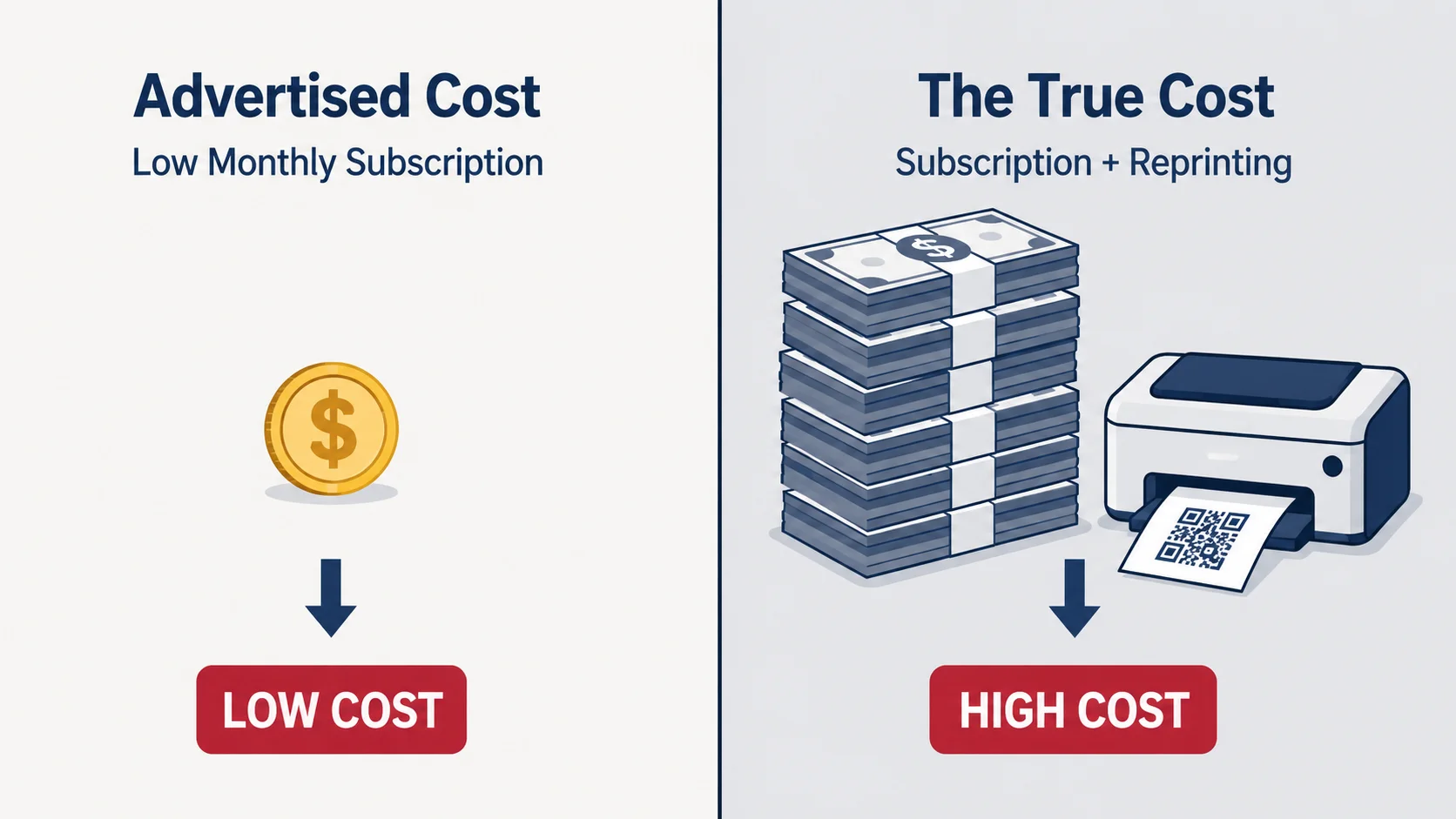
The visible cost of QR code subscriptions is the monthly or annual fee. The hidden cost — the one that never appears on pricing pages — is the cost of materials that become worthless when codes deactivate. Here's what that looks like in practice:
| Scenario | Platform fee | Materials cost (if reprinted) | Total actual cost |
|---|---|---|---|
| Restaurant menus, 200 copies, missed trial deadline | $0 (didn't subscribe) | $300–800 reprinting | $300–800 |
| Wedding stationery, cancelled after 1 year | $35/month × 12 = $420 | $175–2,000 reprint | $595–2,420 |
| Product packaging, 10,000 units, subscription lapsed | $0 (billing failed) | $5,000–40,000 reprint or sticker overlay | $5,000–40,000 |
| Annual plan auto-renewed, cancelled month 2 | $420/year (non-refundable) | $0 (caught before printing) | $420 (10 unused months) |
In our review of user complaints across Trustpilot, Reddit, and review aggregators in May 2026, reprinting costs — not subscription fees — represent the majority of reported financial harm from QR code subscription traps. The subscription fee is irritating. The reprint bill is the actual damage.
How to test if your QR code will survive cancellation
Before printing anything on physical materials, run this test. Two minutes. It will tell you exactly what you're dealing with.
Step 1: Scan the code and capture the URL. Open a QR scanner (your phone's camera app works). When the code scans, do not tap the link. Instead, long-press or look at the preview URL. Note the domain: is it your domain, or the platform's domain?
Step 2: Check whether the URL is a redirect. If the URL is something like qr1.io/xyz or qrti.co/abc, paste it into a browser and use a redirect checker tool. You'll see: URL 1 (platform short URL) → 302 redirect → URL 2 (your actual page). URL 1 is the one that breaks when you cancel.
Step 3: Cancel a test account before printing. This is the definitive test. Create a trial account, generate a code, cancel the trial, and scan the code again 24 hours later. If it still redirects, the platform's codes survive cancellation. If it fails, you have your answer before you've committed any materials to print.
Most users skip Step 3. Most users who report subscription trap complaints also report they had already printed materials before testing cancellation behavior. If you are already in the trap with printed materials, see what to do when your QR code is held hostage for recovery options.
Named platforms and their documented practices (May 2026)
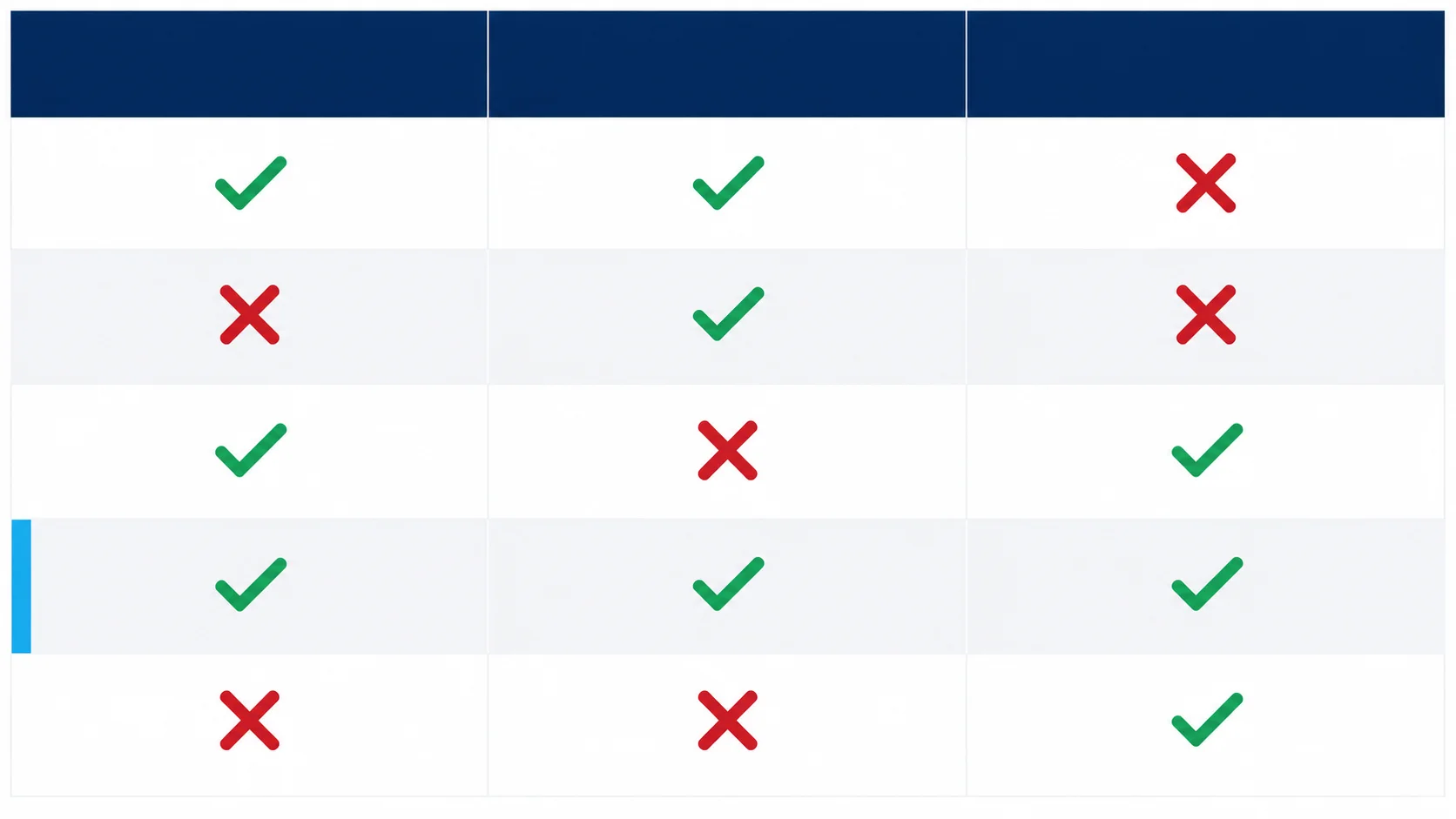
Naming specific platforms is useful because the complaint patterns are consistent. This is not an allegation of fraud — these are documented platform policies and user-reported experiences.
- qr.io: 7-day free trial. Post-trial pricing: $35/month. The homepage does not display pricing or trial duration. A graphic designer on Wilkinson.Graphics documented the full funnel in July 2025: searched "QR code generator," landed on a sponsored result, designed a code, discovered the $35/month requirement only after attempting to download. The code encodes a qr1.io short URL.
- QRFY: 7-day free trial. Support documentation explicitly states dynamic codes created during trial deactivate after trial ends. One user reported a $120 minimum subscription commitment required to recover already-printed materials.
- QR Code Creator (qrcodecreator.com): SmartCustomer review aggregation shows consistent reports of auto-renewal at $133/year after trial. Multiple reviewers describe the cancellation flow as deliberately confusing.
- QR Tiger: Not a trial trap — pricing is disclosed. The documented issue is the 500-scan cap on free dynamic codes: after 500 scans, the code stops redirecting until the next billing cycle. This is disclosed in plan details but not prominently at code creation. Users running live campaigns on the free tier report codes failing silently mid-campaign.
- QR Code Generator PRO (qr-code-generator.com): Rated 1.5/5 on Trustpilot. Documented complaints center on annual billing default, non-refundable policy on unused months, and slow support response when codes fail. The support FAQ confirms auto-renewal is on by default and must be manually disabled before the renewal date.
The regulatory backdrop: why this is being treated seriously
These practices are not just ethically questionable — they're increasingly illegal. For a broader look at deceptive patterns across the QR generator market, see QR code generator scams to avoid. In September 2025, the FTC secured a $2.5 billion settlement against Amazon for subscription dark patterns related to Prime: $1 billion in civil penalties and $1.5 billion in consumer refunds. That settlement defined what "informed consent" means for subscription auto-renewal in US federal practice.
On January 30, 2026, the FTC submitted an Advance Notice of Proposed Rulemaking to restart its negative option regulations after the Eighth Circuit vacated its Click-to-Cancel Rule in July 2025. The rulemaking targets auto-renewal subscriptions where cancellation is harder than enrollment and where material terms are not disclosed before payment.
In the UK and EU, similar regulations are in progress under the Digital Markets, Competition and Consumers Act 2024 and the EU's 2023 Consumer Omnibus Directive. The direction is clear: subscription dark patterns are facing a legal reckoning in every major market.
When a dynamic QR code subscription is the right choice anyway
This article is not arguing that all QR code subscriptions are scams. Some use cases genuinely require dynamic codes with platform infrastructure, and the subscription model makes sense when:
- You need to change the destination URL after printing — event landing pages, limited-time offers, rotating campaigns
- You need scan analytics: location data, device type, scan frequency — useful for measuring print campaign ROI
- The materials have a defined end date shorter than your subscription period — a trade show flyer, a seasonal promotion
For these use cases, a subscription is the right model. The problem isn't paying for infrastructure — it's not knowing that's what you're doing, and not knowing what happens when the relationship ends. The subscription trap is a disclosure problem, not a pricing problem.
The honest alternative: permanent codes, no subscription required
QR Nova was built around one structural premise: a QR code you create should keep working regardless of what happens to your payment relationship with us. Here's what that means in practice:
Static QR codes at QR Nova are free, unlimited, require no account, and have no scan limits. The destination URL is encoded in the image. No server. No redirect. No expiration. You can generate a static QR code right now and it will scan on a document printed in 2035 exactly as it does today.
Dynamic codes at QR Nova use redirect infrastructure designed to outlast the subscription relationship. The redirect remains active after cancellation — not as a courtesy, but as a structural design choice. We don't profit from deactivating your codes. If you cancel, your codes keep working.
Transparent pricing means all limits, all terms, and all cancellation behavior are disclosed on the pricing page before you create a single code. There are no annual billing defaults — you choose your billing cycle. Unused months are refundable within 30 days.
For a direct comparison of how QR Nova stacks up against the platforms named in this article, see the comparison pages — each one includes the cancellation behavior, billing defaults, and scan limits for the platform in question.
Frequently asked questions
Is the QR code subscription model a scam?
It depends on your definition. The subscription model itself is legal, but many platforms use dark patterns that qualify as deceptive: codes that deactivate silently after trial without clear warning, auto-renewal billed annually by default, and refund policies that block chargebacks on unused subscription months. The FTC has been targeting these practices since 2024.
What happens to my QR codes if I cancel my subscription?
On most major platforms — QR Tiger, Flowcode, Bitly, QR Code Generator PRO — dynamic QR codes deactivate immediately or within days of cancellation. The codes redirect through the platform's short-URL servers, which shut down for unpaid accounts. Static QR codes always survive cancellation because the destination URL is encoded in the image itself.
Do free QR code generators deactivate codes?
Some do, some don't. Platforms that offer 'free' dynamic codes typically cap scans (QR Tiger caps free codes at 500 scans) or expire them after a trial period. QRFY explicitly states that codes created during its 7-day free trial deactivate when the trial ends. Static codes from any platform never require a server and never deactivate.
What is a dynamic QR code and why does it expire?
A dynamic QR code encodes a short URL that redirects to your actual destination. The redirect happens on the platform's servers. When you stop paying, the platform stops running the redirect for your code — so the QR code scans successfully but the redirect fails, showing an error or blank page. The expiration is a business decision, not a technical necessity.
How do I test if my QR code will survive cancellation?
Scan the QR code and check the URL it opens. If the URL is the platform's own short domain (e.g., qr1.io/abc123 or flowco.de/xyz), your code depends on that platform's servers. If the URL matches your own domain directly, it may be static. The safest test: cancel a trial before printing anything, then scan the code again and see if it resolves.
Which QR code generators have hidden fees?
As of May 2026, platforms with documented deceptive practices include qr.io (7-day trial then $35/month, no prominent disclosure on homepage), QR Code Creator (auto-renews at $133/year after trial), and QR Code Generator PRO (annual billing default, no refund on unused months). QR Tiger is transparent about its model but buries the 500-scan cap on free codes in plan details.
Can I get a refund if I was charged by a QR code generator?
Most platforms explicitly state that subscription fees are non-refundable, including unused months. Your best recourse is a credit card chargeback if the billing was genuinely deceptive — most card issuers accept 'service not as described' disputes for subscriptions with undisclosed auto-renewal. File with your card issuer within 60 days of the charge.
What QR code generator does not require a subscription?
QR Nova generates unlimited static QR codes free with no account, no scan limits, and no expiration. Dynamic codes at QR Nova are structured so they remain active without a paid subscription. QR Code Monkey offers unlimited free static codes with no subscription. Canva and Adobe Express can generate static QR codes at no cost.
Related articles
QR Code Generator Scams to Avoid (2026)
QR code generator scam patterns exposed: free trial traps, scan caps, held-hostage codes. How to identify them before you print. Real examples, April 2026.
Do QR Tiger Codes Expire? What Happens When You Cancel
Do QR Tiger codes expire? Free codes die at 500 scans, paid codes deactivate when you cancel. Which codes survive, and how to avoid the trap.
Dynamic QR Code Scam: 2 Traps to Avoid (2026)
A dynamic QR code scam has two forms: predatory platforms that deactivate your codes, and criminals who swap the destination. How to spot both.
Start free — no subscription trap
Get started