QR Code Anti-Counterfeiting Serialization: Technical Guide
QR code anti-counterfeiting serialization explained: how serialized codes work, EU FMD, US DSCSA, GS1 Digital Link, NFC hybrids, and how to spot a fake.
This article was written by the QR Nova team. We build QR code software, which may inform our perspective.
TL;DR
- Serialized QR codes encode a unique per-unit identifier, not a shared product URL — each scan is logged and any reuse is detectable.
- EU FMD (pharma, since 2019) and US DSCSA (pharma, enforcement 2023–2024) mandate 2D barcode serialization; GS1 Digital Link satisfies both when properly structured.
- NFC + QR hybrids are the high-security standard for luxury goods — NFC cannot be optically copied, QR provides consumer-accessible verification.
- The global QR anti-counterfeiting label market was USD 3.5 billion in 2024 and is projected to reach USD 7.1 billion by 2032 (24 Market Reports, 2024).
What QR Code Serialization Is and Why It Matters
Generate your first QR code — free
Get startedhttps://brand.com/products/shampoo — identical on every bottle, printable by anyone with a QR generator. A serialized code encodes https://brand.com/verify?sn=SN-20240816-00047382: a one-time identifier that was registered in the database before the bottle left the factory.
That single shift changes the threat model entirely.
The Three Counterfeit Attack Vectors Serialization Defeats
- Clone attack: A counterfeiter photocopies the QR code from a real product and affixes it to a fake. When the first legitimate consumer scans the original product, the database records one verified scan from City A. When the second consumer (who bought the fake) scans the copy in City B, the system returns "already verified" or triggers a geographic anomaly alert.
- Ghost inventory attack: A distributor creates phantom units using made-up serial numbers. Because those numbers were never registered in the manufacturer's database, every scan returns "not found."
- Diversion attack: A product manufactured for one market (e.g., lower-priced for Southeast Asia) is diverted and sold in Europe. The serialization database encodes the intended market, and a scan from the wrong geography flags the diversion automatically.
How Serialized QR Codes Work Technically
The verification flow has four components: the code generation layer, the database layer, the scan event layer, and the response layer. Code generation: Each serial number is generated using a cryptographically secure random number generator, producing a string long enough that brute-force guessing is computationally infeasible. Common formats are 12–20 alphanumeric characters or UUID-based identifiers. These are generated in batch during production scheduling — not at print time — and pre-registered in the database before any unit ships. Database layer: The central registry stores the authoritative record for each serial number: product SKU, batch/lot, manufacture date, pack date, intended market, distribution chain milestones, and verification history. This database is write-once for the serial registration (no one can add new legitimate serials after the production run closes) but write-many for scan events. Scan event layer: Every scan triggers an API call from the consumer's device to the verification endpoint. The call includes the serial number extracted from the QR code, the timestamp, and optionally the device's IP-derived geolocation. The system logs the event and evaluates it against the expected scan profile. Response layer: The API returns a verdict: authentic, suspicious, or not found. Sophisticated implementations return graduated responses — "first scan, authentic," "second scan from different continent, contact support," "not registered, suspected counterfeit."Track-and-Trace Use Cases by Industry
Pharmaceuticals — EU FMD and US DSCSA
Pharmaceutical serialization is the most regulated deployment context. Two frameworks dominate. The EU Falsified Medicines Directive (Delegated Regulation 2016/161) became mandatory in February 2019 for all prescription medicines sold in the EU. Each pack must carry a 2D barcode encoding four data elements in GS1 Application Identifier format: the GTIN (AI 01), the serial number (AI 21), the batch number (AI 10), and the expiry date (AI 17). The barcode must be verified against the European Medicines Verification System (EMVS) at dispensing. The US Drug Supply Chain Security Act (DSCSA) reached its enforcement milestone for manufacturer-level unit-level product identifiers in November 2023. The full interoperable electronic tracing requirement — requiring all supply chain partners to exchange transaction information at the unit level — reached full enforcement in November 2024. DSCSA uses the same GS1 data elements as FMD: GTIN + serial number + lot + expiry in a 2D barcode. GS1 Digital Link can encode all four FMD/DSCSA data elements in a single QR code URI, making one code scannable by both a pharmacist's verification system and a patient's smartphone at the same time.Luxury Goods
The luxury sector loses an estimated EUR 26 billion annually to counterfeiting (European Union Intellectual Property Office, 2022). Unlike pharma, there is no single mandatory anti-counterfeiting regulatory framework. Most implementations are brand-driven, which means quality varies wildly across the industry. LVMH, Richemont, and Kering have deployed serialized QR codes or NFC chips (or both) across product lines. The verification model differs from pharma: rather than a centralized external registry, luxury brands typically run their own verification servers, often integrated with CRM to capture first-scan ownership registration.Food Safety and FSMA Rule 204
The US FDA's Food Safety Modernization Act Rule 204 (effective January 2026 for large companies) requires companies handling high-risk foods to maintain electronic records and make them available to FDA within 24 hours of a request. A lot number encoded in a QR code enables instant chain-of-custody retrieval during a recall. Unilever deployed QR codes on Knorr packaging across multiple markets to trace products back to source farms. In documented contamination responses, brands with QR-linked lot traceability have isolated affected batches in under 4 hours; brands relying on paper records have taken days.GS1 Digital Link — The Standard for Serialized QR Codes
GS1 Digital Link (ISO/IEC 18975) is the specification that turns a QR code into a standards-compliant supply chain identifier. The URI structure embeds the GTIN and serial number directly in the URL path:https://verify.brand.com/01/07622300123458/21/SN-20240816-00047382/10/LOT-A?17=270131
This structure means the code is scannable by:
- A pharmacist's dispensing system extracting GS1 data elements for FMD/DSCSA verification
- A warehouse scanner recording receipt into an ERP system
- A consumer's phone camera opening a product authentication page
NFC + QR Hybrid Approaches for High-Value Items
A QR code can be photographed. An NFC chip cannot. This asymmetry is why high-value product authentication increasingly combines both. The hybrid model works like this: an NFC chip (typically a 13.56 MHz passive RFID tag) is embedded in the product or packaging, and a QR code is printed on the exterior. The QR code handles consumer-accessible verification — scan with any phone camera, no app needed. The NFC tap provides a secondary check that requires physical contact with the original chip. Counterfeiting an NFC-equipped product requires cloning the chip's unique identifier (UID), which is factory-locked on modern NTAG chips. NXP's NTAG 424 DNA series uses AES-128 encryption and a rolling authentication code — each tap produces a different cryptographic response, so even a perfect electrical clone of the chip state becomes invalid after one tap. Current deployments: Prada uses NXP-based NFC chips on handbags (launched at scale in 2022), LVMH's Aura blockchain platform integrates NFC with digital product passport data, and several premium spirits brands use NFC closures that stop working once the bottle is opened.How to Spot a Fake QR Code
This section is for consumers scanning products in the wild. Three signals are diagnostic. Signal 1 — Domain mismatch. The QR code should redirect to the brand's official domain or a named verification service they explicitly list on their website. Counterfeiters use lookalike domains:ver1fy-brand.com, brand-authentic.net, or completely unrelated domains. Before entering any information, check the full URL in your browser bar.
Signal 2 — The page asks for data before showing verification status. Legitimate authentication flows show "Authentic" or "Suspicious" before requesting anything. Any page that requires your email, phone number, or payment information before displaying a result is not a brand protection implementation. It is a phishing or upselling operation.
Signal 3 — Scan count anomalies. Well-designed consumer-facing verification pages show the scan history for that unit: first scan date, location, and whether this is a repeat scan. "This product has been scanned 847 times in the last hour from 23 countries" is a clear counterfeit signal. "First scan, authentic, manufactured March 2026, batch LOT-A26" is what genuine verification looks like.
Implementation Guide: Choosing a Serialization Platform
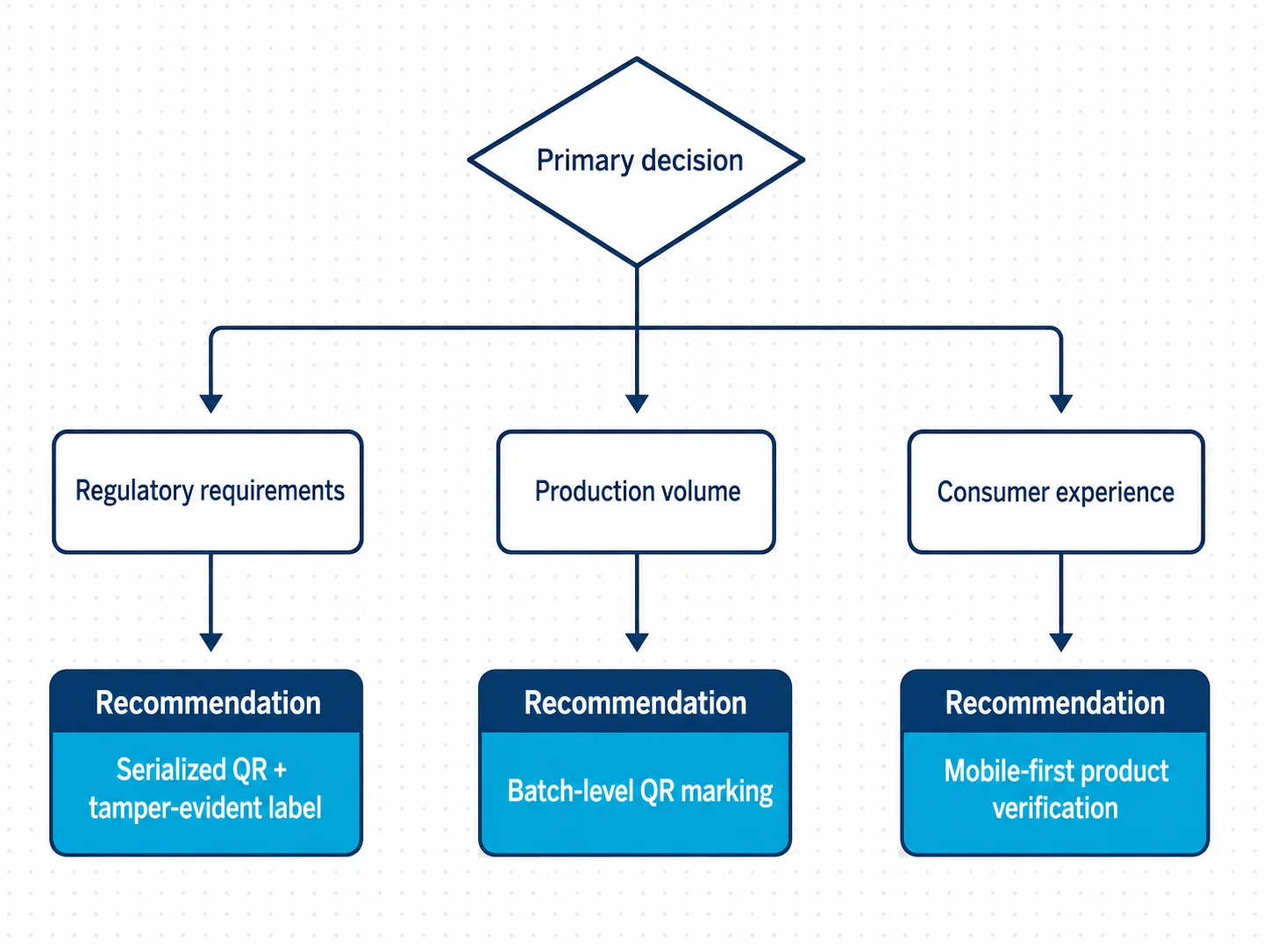 The decision depends on three factors: regulatory requirement, annual production volume, and required consumer experience.
Regulatory requirement: If you are in EU pharma or US pharma, you need GS1-compliant serialization with a validated verification system. The platform must support GS1 Application Identifiers and integrate with EMVS (EU) or support compliant data exchange (US DSCSA). This narrows choices to enterprise platforms: Systech, Antares Vision Group, rfxcel, or custom GS1 Digital Link implementations.
Production volume: Serialization at 1 million units per year and serialization at 1 billion units per year are different engineering problems. At high volumes, serial number generation and database write throughput become bottlenecks. Platforms like Optel and Systech are designed for multi-billion-unit pharmaceutical lines. For smaller volumes (under 500,000 units annually), mid-market platforms like Scantrust or Authena offer managed serialization without enterprise integration overhead.
Consumer experience requirement: Pure supply chain traceability with no consumer touchpoint simplifies the architecture — you need generation, database, and trade partner data exchange, but no consumer-facing resolver. Brand protection with consumer verification requires a mobile-optimized landing page, often with product registration, warranty activation, or loyalty program integration.
The decision depends on three factors: regulatory requirement, annual production volume, and required consumer experience.
Regulatory requirement: If you are in EU pharma or US pharma, you need GS1-compliant serialization with a validated verification system. The platform must support GS1 Application Identifiers and integrate with EMVS (EU) or support compliant data exchange (US DSCSA). This narrows choices to enterprise platforms: Systech, Antares Vision Group, rfxcel, or custom GS1 Digital Link implementations.
Production volume: Serialization at 1 million units per year and serialization at 1 billion units per year are different engineering problems. At high volumes, serial number generation and database write throughput become bottlenecks. Platforms like Optel and Systech are designed for multi-billion-unit pharmaceutical lines. For smaller volumes (under 500,000 units annually), mid-market platforms like Scantrust or Authena offer managed serialization without enterprise integration overhead.
Consumer experience requirement: Pure supply chain traceability with no consumer touchpoint simplifies the architecture — you need generation, database, and trade partner data exchange, but no consumer-facing resolver. Brand protection with consumer verification requires a mobile-optimized landing page, often with product registration, warranty activation, or loyalty program integration.
Integration Steps
- Acquire a GS1 company prefix and GTIN. GTINs are issued by GS1 Member Organizations in each country. This is a prerequisite for GS1 Digital Link-compliant serialization.
- Define your serial number schema. Decide the format, length, and uniqueness scope. Most regulated industries require at minimum 20 characters of entropy.
- Generate serial numbers in production batches. Serial numbers must be generated before the production run, not during printing. They are pre-registered in the database at this stage.
- Print or apply the QR codes. Industrial inkjet or laser marking systems apply codes at line speed. For labels and packaging, pre-printed serialized labels are an alternative.
- Commission the verification endpoint. Build or deploy the API that handles scan events, logs them, and returns structured responses. Define alert thresholds for scan anomalies.
- Test against real-world scanners. Consumer phone cameras, industrial scanners, and pharmacist dispensing systems have different decoding tolerances. Test all three before launch.
- Establish a recall and decommission process. Products returned or recalled must be decommissioned in the database so their serial numbers do not trigger false-positive authenticity responses post-recall.
Comparing Anti-Counterfeiting Serialization Approaches
Static QR + Centralized Database: Each unit gets a unique static URL. Full control, no external dependencies. Not interoperable with third-party supply chain systems; no structured GS1 data means pharmacist scanners cannot extract it automatically. Best for consumer goods brands without regulatory mandates, or direct-to-consumer luxury. Dynamic QR Redirect: A short redirect URL updated post-print. Architecturally weak for anti-counterfeiting unless combined with per-unit unique codes — and if codes are unique per unit, the redirect layer adds cost and a single-point failure risk. If the redirect service shuts down, all printed codes become dead links. Avoid for serialized anti-counterfeiting. GS1 Digital Link: URI embeds GTIN and serial number in the path. Satisfies EU FMD, US DSCSA, EU Digital Product Passport requirements, and GS1 Sunrise 2027 from a single code. Requires a valid GS1 GTIN and conformant resolver. The right choice for any regulated industry or supply chain with multiple scanning audiences.EMVCo and QR Code Payment Anti-Fraud
This post focuses on product anti-counterfeiting, but the EMVCo QR Code Payment Standard addresses a related but distinct fraud vector: payment credential spoofing via QR codes. The EMVCo framework defends against merchant impersonation — a fraudster placing a fake QR code over a legitimate one at a point-of-sale — using payload CRC verification and transaction-level authentication. If your supply chain involves QR-based payment flows, the two frameworks — product serialization and payment authentication — must be designed as separate layers.How QR Nova Fits Into Your Brand Protection Strategy
For brands needing bulk unique QR code generation for anti-counterfeiting without a per-subscription expiration model, QR Nova supports generating large sets of unique codes, each with distinct payloads. Our codes are permanent: the encoded URL or identifier does not expire because we do not rent you a redirect URL that disappears when you stop paying. The underlying identity is baked into the QR code image itself. For enterprise anti-counterfeiting deployments requiring a live verification database, GS1 Digital Link conformance, or NFC integration, you will need a platform designed for that specific purpose. What QR Nova provides is the generation and bulk-export layer — unique codes at scale, as static payloads you control, that you can wire to your own backend. Generate your first code free and see how the bulk flow works before committing to any architecture.Frequently asked questions
What is QR code serialization for anti-counterfeiting?
QR code serialization assigns a globally unique identifier to each individual product unit — not just the product model. Every code points to a database record that tracks its origin, custody chain, and verification history. When a consumer or inspector scans the code, the system checks whether the code is registered, has been verified before, and whether the product data matches expectations. A counterfeit product either carries a copied code (detectable via scan-count anomalies) or no registered code at all.
How does the EU Falsified Medicines Directive (FMD) use QR codes?
EU FMD (Delegated Regulation 2016/161, effective since February 2019) requires every prescription medicine pack sold in the EU to carry a 2D DataMatrix barcode encoding a GTIN, serial number, batch ID, and expiry date in GS1 Application Identifier format. Dispensing pharmacies must scan and verify each pack against the European Medicines Verification System (EMVS) at the point of dispensing. QR codes are not mandated by FMD but can encode the same GS1 data elements in a GS1 Digital Link URI, making them compliant when the resolver returns the correct structured data.
What is the difference between a serialized QR code and a standard QR code?
A standard QR code encodes a fixed payload — typically a URL — that is identical on every unit of a product. A serialized QR code encodes a unique identifier per unit, linking to a live database record. The uniqueness is what enables verification: you can detect whether a code has been scanned before (reuse attack), whether it was ever manufactured, and whether the supply chain path makes sense geographically and temporally.
How can a consumer tell if a QR code is fake?
Three signals indicate a suspicious QR code: (1) the destination URL is not the brand's official domain — counterfeiters often use lookalike domains; (2) the landing page asks for personal information or payment before showing authentication status; (3) the page shows 'product not found' or 'already verified X times' for a product you just purchased. Legitimate brand protection platforms redirect to an HTTPS page on the brand's own domain or a named verification service.
What is the US DSCSA requirement for pharmaceutical serialization?
The Drug Supply Chain Security Act (DSCSA) requires US pharmaceutical manufacturers, repackagers, wholesale distributors, and dispensers to track prescription drugs at the unit level using a standardized identifier. As of November 2023, manufacturers must affix a product identifier encoding the GTIN, serial number, lot number, and expiration date in a 2D barcode (typically DataMatrix or QR). The full interoperable electronic tracing system reached its final enforcement milestone in November 2024.
Can a QR code be copied by counterfeiters?
Yes — a QR code image can be photographed and reprinted. This is why image-level copying is not the threat model that serialization defends against. The defense is at the database layer: each unique serial number is registered once. When the same serial number is scanned by two different consumers in different locations within a short window, the verification system flags the second scan as suspicious. High-security products add physical layer defenses — holograms, thermochromic inks, or NFC chips — that cannot be optically duplicated.
What platforms handle serialized QR code generation at scale?
Enterprise-grade platforms include Systech (pharma focus, acquired by Markem-Imaje), Optel Group, rfxcel (now Antares Vision Group), Verify Brand, Scantrust, and Laava. For GS1 Digital Link-compliant serialization, the GS1 open-source resolver software supports custom deployments. For luxury goods, Authena and Selinko offer serialized QR with blockchain anchoring. For bulk unique-per-item QR code generation without a verification database, QR Nova supports export of large batches of unique codes.
What is the QR code anti-counterfeiting label market size?
According to 24 Market Reports (2024), the global QR code anti-counterfeiting label market was valued at USD 3.5 billion in 2024 and is projected to reach USD 7.1 billion by 2032, growing at a CAGR of 8.5%. The pharma vertical accounts for the largest share, driven by mandatory serialization regulations in the EU, US, China, India, and Brazil.
Related articles
GS1 Digital Link QR Code Implementation: The Technical Guide
GS1 Digital Link QR code implementation: URI structure, resolver setup, GTIN encoding, retail and healthcare use cases, plus 5 pitfalls to avoid.
EU Digital Product Passport QR Code: Manufacturer Guide
EU Digital Product Passport requires a GS1 Digital Link QR code on every product sold in the EU. Deadlines, data requirements, and what to get right now.
QR Code Supply Chain Traceability: GS1, DSCSA, Failures
QR code supply chain traceability explained — GS1 Digital Link, DSCSA, EU DPP, lot tracking, and why platform-dependent codes fail. No sign-up required.
Generate your first QR code — free
Get started