QR Code Supply Chain Traceability: GS1, DSCSA, Failures
QR code supply chain traceability explained — GS1 Digital Link, DSCSA, EU DPP, lot tracking, and why platform-dependent codes fail. No sign-up required.
This article was written by the QR Nova team. We build QR code software, which may inform our perspective.
Most QR code supply chain guides treat the symbology as a solved problem. Print a code, scan a code — done. The complexity, they imply, lives in the software: the WMS, the ERP, the traceability platform. The QR code is just a carrier.
That framing gets companies into serious trouble. QR codes on physical labels have a lifespan measured in years, sometimes decades. The supply chain software they point to turns over every three to five years. When those timelines collide — platform sunsets, vendor acquisitions, subscription lapses — a production run full of labels becomes a liability. Not a traceability asset.
QR code supply chain traceability works when the code survives independently of the platform that created it. The choice of QR standard (GS1 Digital Link, static GTIN encoding, or redirect-based URL) determines whether your traceability survives a vendor change. The choice of generator determines whether the code survives at all.
TL;DR
- GS1 Digital Link is the backbone of modern supply chain QR — it encodes GTIN, lot, batch, expiry, and serial in a structured URL that any resolver can handle
- DSCSA (pharma, US), FMD (pharma, EU), FSMA 204 (food, US), and the EU Digital Product Passport (all product categories, from 2026) are the four major regulatory drivers right now
- Static QR codes are the right choice for lot/batch labels — the data is fixed at print time and must remain scannable for the product's full shelf life
- Platform-dependent QR codes (redirect-based) are a single point of failure on physical labels — when the service lapses, years of labels become dead links
- Error correction Level Q or H is required for industrial labels subject to cold storage, UV, or physical abrasion
What Supply Chain Traceability Actually Requires from a QR Code
Create your first QR code — free
Get startedA QR code on a supply chain label is just a carrier for structured identifiers — GTIN, lot number, expiry date, serial number. The value is what happens at each scan: a timestamped record gets written to a chain-of-custody log, tying that physical unit to a specific logistics event. Receiving dock. Cold storage intake. Picking. Shipping. Each scan updates the record automatically, without manual transcription.
The standard that defines how those identifiers get encoded is GS1. Two layers matter:
- GS1 Application Identifiers (AIs) — numeric prefixes that tell a scanner what the following data means. AI (01) = GTIN. AI (10) = batch/lot. AI (17) = expiry date. AI (21) = serial number. These AIs can be encoded in GS1-128 linear barcodes, GS1 DataMatrix, or QR codes.
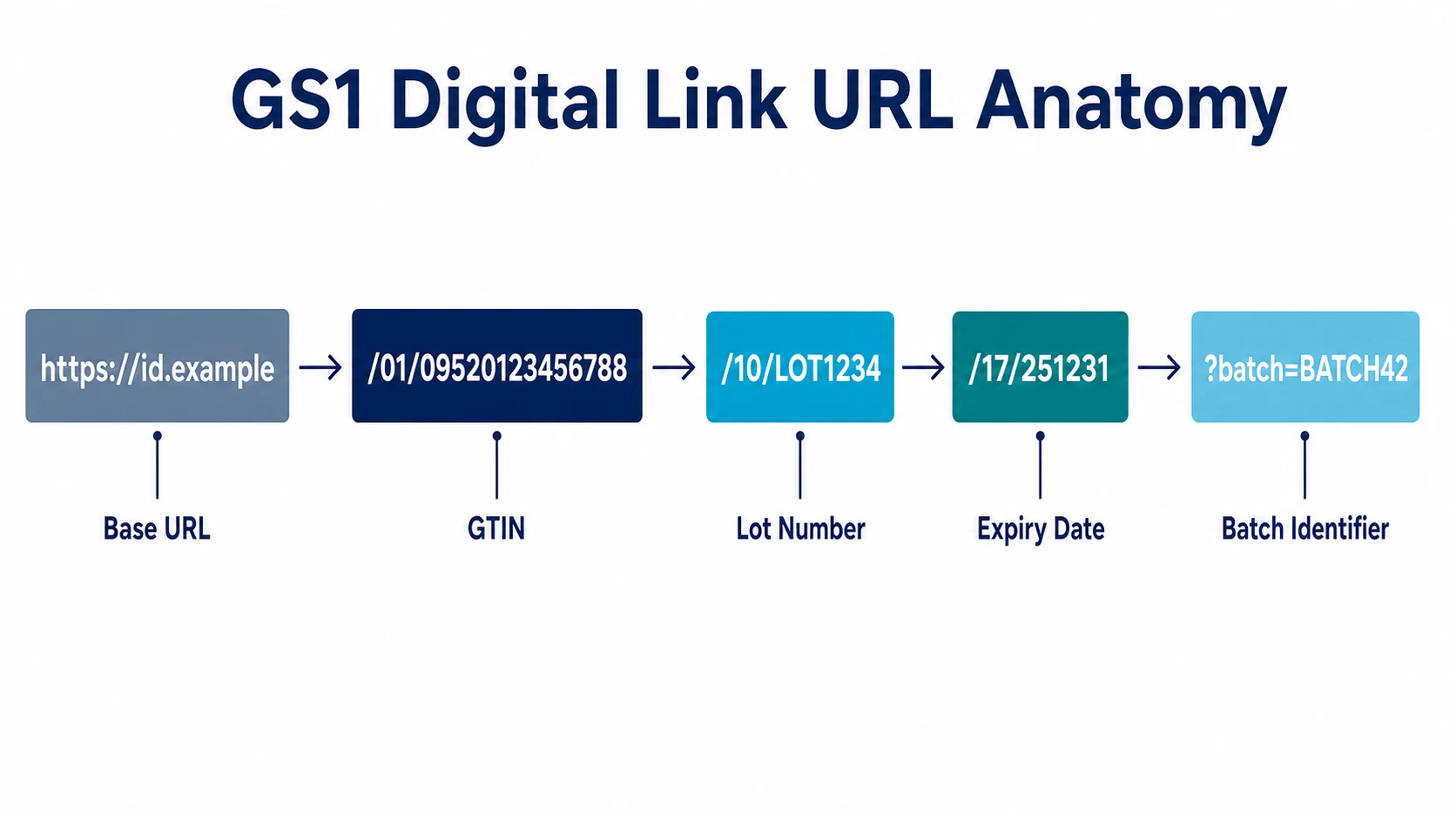
- GS1 Digital Link — a URI standard (published as GS1 Digital Link 1.2) that structures those same identifiers as a web-resolvable URL. A GS1 Digital Link QR code encodes something like
https://id.gs1.org/01/09506000134352/10/LOT-1234/17/251231. Scanners at the dock parse the identifiers from the URL path. Consumer devices get routed to a product information page by the resolver.
GS1 Digital Link vs. GS1-128: What Changed
GS1-128 linear barcodes have been the supply chain standard for 30 years. They work. The problem is they carry only machine-readable data — a dock scanner parses them, but a consumer phone camera gets nothing useful beyond a string of digits.
GS1 Digital Link QR codes carry the same structured identifiers in a URL format, so one symbol handles both the dock scanner reading AI (01) and AI (10) for lot verification, and the consumer phone that opens a product page. GS1's Sunrise 2027 initiative targets retail adoption of GS1 Digital Link 2D barcodes at checkout globally by January 2027, replacing GS1-128 and EAN-13. That deadline is moving faster than most brand owners realize.
The practical implication for supply chain teams: new label designs should encode GS1 Digital Link QR codes, not GS1-128, so the same label works at the dock, at retail checkout, and for regulatory submissions. ISO 18004 QR code encoding requirements are worth understanding before setting up any GS1 Digital Link label program.
The Four Regulatory Frameworks Driving Adoption Right Now
Efficiency gains rarely drive QR traceability adoption. Compliance pressure does. Here are the four regulatory frameworks supply chain teams cannot ignore in 2026.
1. DSCSA — US Pharmaceutical Serialization
The Drug Supply Chain Security Act (DSCSA) required serialized product identifiers on prescription drug packages from November 2023. The identifier must encode GTIN, serial number, lot number, and expiry date — the same data carried by GS1 DataMatrix or QR on item-level packages.
The FDA's interoperability stabilization period runs through November 2025. After that, trading partners must exchange and verify electronic traceability data in a standardized format. Manufacturers still printing non-serialized labels, or using platform-specific barcodes without GS1 AIs, are non-compliant now.
2. FMD — EU Pharmaceutical Anti-Counterfeiting
The EU Falsified Medicines Directive (Delegated Regulation 2016/161) requires a unique identifier and anti-tampering device on prescription medicines placed on the EU market. The unique identifier must include product code (GTIN), serial number, national reimbursement number (where applicable), batch number, and expiry date — encoded in a 2D Data Matrix barcode. QR codes are an accepted alternative carrier.
One thing FMD makes explicit that other regulations leave implied: manufacturers scanning against the EU Medicines Verification System (EMVS) must use the encoded identifiers verbatim. A redirect URL that resolves to the identifier will not pass verification. The barcode encodes the actual identifiers — not a pointer to them. That distinction rules out every platform-dependent redirect approach for FMD-regulated products.
3. FSMA 204 — US Food Traceability
FDA Rule 21 CFR Part 1, Subpart S (FSMA Rule 204) applies to foods on the Food Traceability List — leafy greens, fresh-cut produce, shell eggs, nut butters, and others. Covered businesses must maintain Key Data Elements (KDEs) at each Critical Tracking Event (CTE) and make those records available to FDA within 24 hours on request, starting January 2026 (enforcement flexibility through mid-2026 for small businesses).
FSMA 204 does not mandate a specific barcode format. The GS1 QR code carrying GTIN (AI 01) plus lot number (AI 10) plus harvest date (AI 13) is the standard industry approach because it links the physical case to the KDE record without manual transcription. A QR code encoding a redirect URL — rather than the actual lot identifier — creates a real compliance gap: if the redirect service is down during an audit, the tracing record cannot be verified and the 24-hour retrieval window becomes a problem.
4. EU Digital Product Passport (ESPR)
The Ecodesign for Sustainable Products Regulation (ESPR) requires a Digital Product Passport for product categories entering scope progressively from 2026. The European Commission's 2025–2030 working plan (published April 2025) identifies the first cohorts: batteries are already covered under EU Battery Regulation 2023/1542 (DPP requirements phasing from 2027), followed by textiles, steel and aluminum, furniture, and tires.
The DPP must be accessible via a data carrier on the product. GS1 proposes a Digital Link QR code as the preferred carrier, with the resolver pointing to the DPP record. The DPP must stay accessible for the product's full lifecycle — for industrial equipment or textiles, that can mean decades. A redirect service that shuts down midway through that window is not an inconvenience. It is a regulatory compliance failure embedded in a label you cannot recall.
Concrete Failure Modes: How Supply Chain QR Codes Break
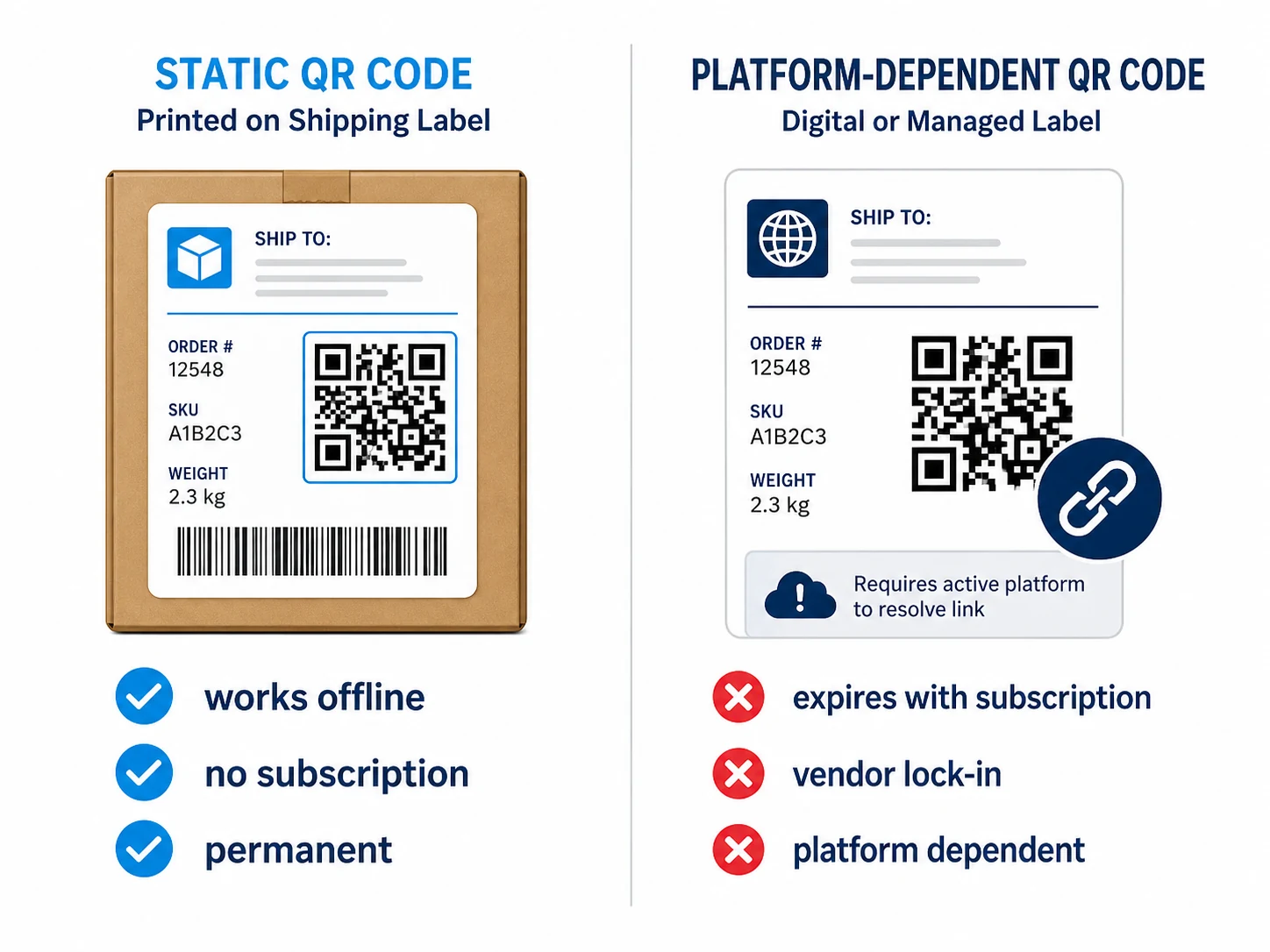
Supply chain QR code failures fall into three categories with different root causes and different prevention strategies. Platform dependency accounts for the majority of silent failures — codes that scan without error on the generator's own interface but return dead URLs during a regulatory audit years later.
Failure Mode 1: Platform Dependency and Service Shutdown
The most commercially damaging failure is also the least discussed. QR codes that encode a redirect URL hosted by a third-party platform work fine until the company cancels the subscription, the vendor exits the market, or the service gets acquired and sunset. At that point, every label in circulation — warehouse stock, retail shelf, product already in a customer's hands — scans to an error page.
Labels are printed in bulk months before products ship. Products stay in distribution for months or years after that. Regulatory audits can require a scan to return valid traceability data long after the product was manufactured. Each of those timelines extends the window of exposure.
The mitigation is encoding the actual GS1 identifiers directly — static lot data in the QR code — or using a GS1 Digital Link URL on a domain your organization owns and controls. Either approach removes the platform as a single point of failure.
Failure Mode 2: Label Degradation
Industrial supply chain environments are hard on printed labels. Cold chain introduces condensation cycles that cause adhesive failure and ink spread. UV exposure bleaches module contrast. Forklift abrasion hits case label corners at predictable angles. Conveyor friction tears labels in transit. These are not edge cases — they are the normal operating environment.
ISO/IEC 18004 recommends Error Correction Level M (15% recovery) for most uses. For industrial supply chain labels, Level Q (25% recovery) is the practical floor, and Level H (30%) is right for labels on metal surfaces or items passing through washdown environments. A code printed at Level L to squeeze in more data will fail at first scan on any label that has seen real warehouse handling.
Print technology matters just as much. Direct thermal printing — standard in warehouse label printing — fades with heat exposure. Thermal transfer with resin ribbons is significantly more durable for cold storage and high-temperature environments. A QR code at 203 DPI on direct thermal stock will fail within weeks in a freezer; the same data on 300 DPI thermal transfer survives years. That difference has nothing to do with the QR generator and everything to do with the print spec.
Failure Mode 3: GS1 Encoding Errors
GS1 Application Identifier syntax is strict. The GTIN in AI (01) must be exactly 14 digits. The lot number in AI (10) is variable-length, terminated by a function code (FNC1) in Code 128 or by the field separator character in GS1 Digital Link. An expiry date in AI (17) must use YYMMDD format, no separators.
When software generates barcodes directly from ERP fields without validating GS1 syntax, the result is a code that a consumer QR app reads without complaint — but that a dock scanner running GS1 validation rejects at intake. The rejection happens at the receiving dock, not at the printing station. By then the error has already propagated through the distribution chain.
GS1 Digital Link URLs are more forgiving here: the URL structure makes identifier fields visually inspectable, and a resolver can flag format errors before the product leaves the warehouse. This is one concrete reason to prefer Digital Link over raw AI encoding for new label programs.
Static vs. Dynamic QR Codes for Supply Chain Labels
The static vs. dynamic question in supply chain is less about preference and more about what the code needs to do over time.
When Static Codes Are the Right Answer
Lot and batch labels are the clearest case for static QR codes. The data — GTIN, lot number, expiry date — is set at print time and must not change. The label has to remain scannable for the product's full shelf life, with no network dependency. A static code encoding a GS1 Digital Link URL with real identifiers works offline, survives vendor changes, and requires no account to maintain.
One thing worth understanding: static does not mean simple. A static GS1 Digital Link QR code carrying a full set of AIs (GTIN + lot + expiry + serial) encodes more structured data than a dynamic redirect code, works without an internet connection at the dock, and cannot be broken by a platform change. It is the more capable option — and QR codes cannot replace full EDI integration for high-volume warehouse systems, but as a last-mile identifier they outperform redirect-based approaches in every traceability scenario that matters.
When Dynamic Codes Add Genuine Value
Product information pages, ingredient disclosures, and Digital Product Passport records are where dynamic codes earn their place — when the destination content changes after labels are printed. A textiles manufacturer deploying EU DPP QR codes in 2026 may need to update repair instructions, recycling facility lists, or material declarations after labels are already on garments. A dynamic code pointing to a stable URL on a domain the manufacturer controls handles that without reprinting.
"On a domain the manufacturer controls" is the operative phrase. Dynamic codes encoding a URL on a third-party platform's domain become a liability the moment that vendor relationship ends. Dynamic QR codes are a valid tool. Third-party redirect dependency is the risk.
Industry-Specific Applications
Food and Beverage: Farm-to-Fork Traceability
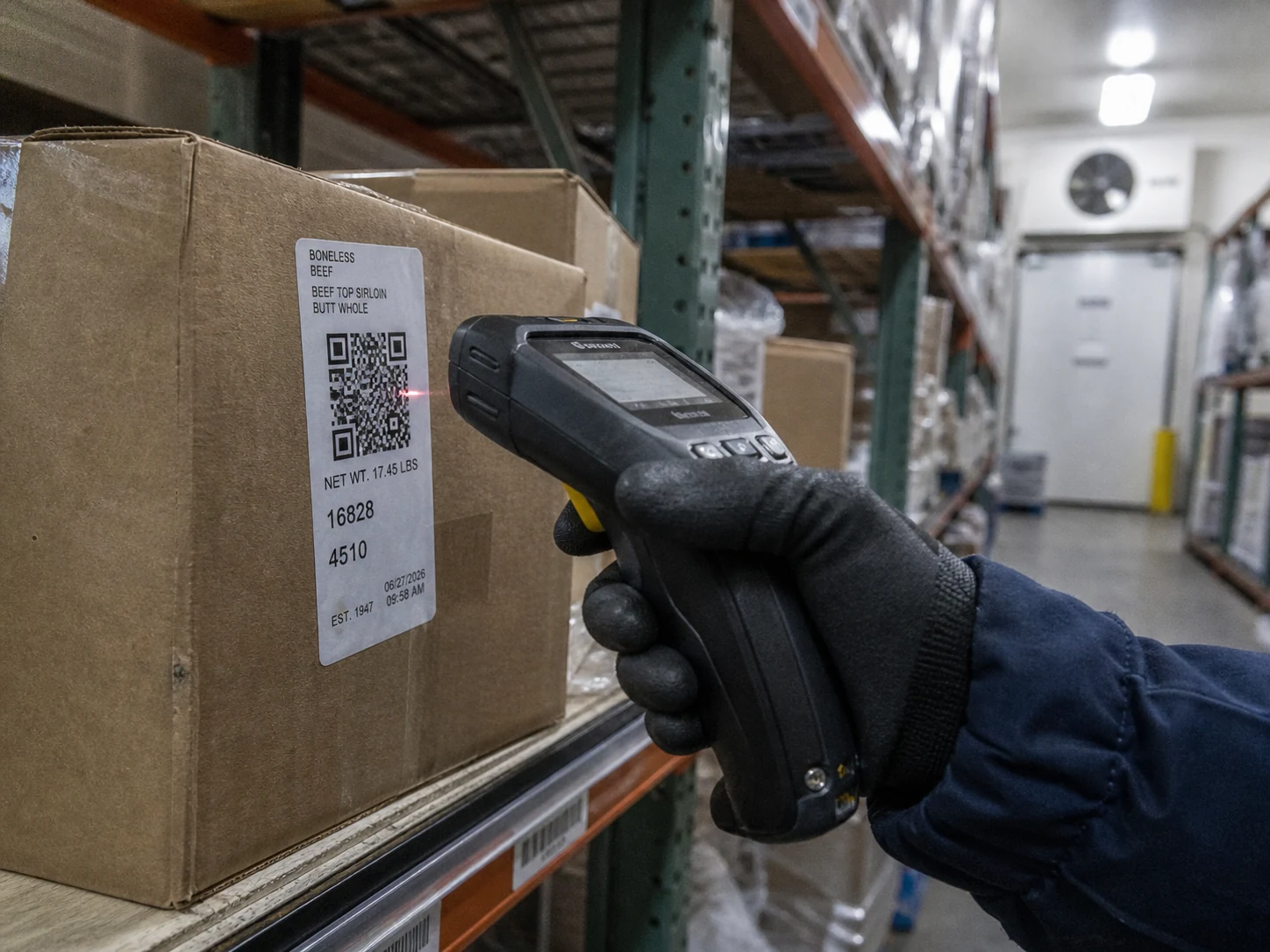
The EU Farm to Fork Strategy and US FSMA 204 converge on the same requirement: a scannable link from the retail unit back to the field, batch, and harvest date. GS1 QR codes on retail cases encode lot and harvest date alongside the GTIN. The scan at the receiving dock populates the KDE record automatically. When a recall triggers, the lot query returns every SKU, every retailer, every shipment date — within the 24-hour FDA window.
The gap most food traceability deployments miss is at the first mile: farm-level lot assignment. Products that mix multiple harvest lots into a single packed case break the lot-level traceability chain at packing. GS1's answer is to assign a new internal lot number at the packing step and record the upstream source lots as sub-lots — maintaining traceability through the consolidation point rather than pretending the mixed lot is a single-origin unit.
Pharmaceutical: Serialization at Item Level
Pharmaceutical serialization is the most mature QR traceability deployment globally — driven by DSCSA in the US and FMD in the EU, it has been running at scale for years. Item-level serialization means every single sellable unit has a unique scannable code, not just a batch label. At dispensing, the pharmacist's scan verifies the package against the EMVS (EU) or the manufacturer's EPCIS repository (US) in real time.
The underlying standard is GS1 EPCIS 2.0 (published 2022), which defines the event vocabulary for pharma serialization. An EPCIS "ObjectEvent" records what product (GTIN + serial), what happened (commissioned, shipped, received), where (GLN), and when. The QR code on the package is the key that unlocks that event log — and the event log is what regulators and trading partners verify, not the label itself.
Luxury Goods: Anti-Counterfeiting
Luxury brands including LVMH, Kering, and Richemont are deploying QR codes as anti-counterfeiting tools, encoding a unique identifier per item that links to a certificate of authenticity. The QR code functions as a digital twin anchor: scan the code, verify the certificate is registered to that serial number, confirm ownership history.
The attack surface counterfeiters actually target is the code itself. A cloned code on a counterfeit item pointing to a legitimate product's record passes a naive scan check. Solutions that hold up include NFC chips paired with the QR code, cryptographically signed identifiers, and physical unclonable function (PUF) materials that cannot be reproduced exactly. QR alone is not sufficient for high-value anti-counterfeiting. QR paired with a signed identifier is a different story.
Implementation Checklist for Supply Chain QR Codes
Before printing a single label:
- Data structure — Confirm which GS1 Application Identifiers are required. DSCSA requires AI 01 + AI 21 + AI 10 + AI 17. FSMA 204 coverage requires AI 01 + AI 10 + harvest date. EU DPP requires a GS1 Digital Link URL resolving to the DPP record.
- URL ownership — If using GS1 Digital Link, confirm the resolver domain is owned by your organization or a GS1 member resolver (id.gs1.org). Do not encode a URL on a platform domain you do not control.
- Error correction level — Minimum Level Q for any label in cold chain, outdoor, or industrial environments. Level H if the label will be on a metal surface or subject to washdown.
- Print technology — Thermal transfer (not direct thermal) for labels exposed to temperatures above 60°C or below 0°C, or to UV exposure exceeding 6 months.
- Quiet zone — Minimum 4 modules on all sides. Verify after print by measuring the actual module size and margin, not the digital design.
- Scan validation — Test every label template with at least three different scanner types: consumer smartphone (iOS native + Android native), handheld dock scanner, and fixed-position tunnel scanner if applicable.
- Permanence — Confirm the generator produces a self-contained QR image that does not depend on a third-party service to resolve. If the code encodes a URL, that URL must point to infrastructure you control or that will outlast the product's shelf life.
When QR Code Traceability Won't Work
QR codes are not the right solution in every supply chain scenario. Getting this wrong is more expensive than getting it right from the start.
- High-density metal surfaces — QR codes printed on bare aluminum or steel without a label substrate fail because module contrast is insufficient for optical scanners. RFID or laser-etched DataMatrix with protective coating is the correct choice for direct part marking on metal components.
- Extreme print resolution constraints — A QR code carrying a full GS1 Digital Link URL (GTIN + lot + expiry + serial) requires a minimum module size of about 0.38 mm for reliable scanning. If your label printer cannot reliably produce that resolution at scale, encoding errors accumulate across production runs. In that scenario, GS1-128 linear barcodes with larger module widths are more reliable, not QR.
- Real-time verification requiring millisecond latency — High-speed conveyor scanning at 600+ items per minute can exceed the decode speed of some QR scanning hardware. GS1 DataMatrix, which has a more compact symbol at equivalent data capacity, performs better in fixed-position tunnel scanners at those speeds.
- Environments with no reliable lighting control — Outdoor receiving docks in direct sunlight create glare on glossy label stock that defeats consumer smartphone cameras. Either matte label stock or a dedicated industrial scanner is required; relying on smartphone scans for compliance verification in those conditions is not viable.
- Minimal GS1 licensing budget — GS1 Company Prefixes require a GS1 membership fee (annual). Businesses that need to encode GS1-compliant GTINs for regulatory submissions must hold a valid GS1 license. QR codes that encode non-GS1 identifiers for internal traceability do not require GS1 membership, but they will not interoperate with trading partner systems expecting GS1 AIs.
How QR Nova Handles Supply Chain Permanence
Platform dependency is a structural problem, not a configuration option. It shows up when a QR generator wraps every code in a redirect URL on the vendor's infrastructure. The vendor's pricing model, acquisition status, and technical decisions get baked into every label ever printed.
QR Nova generates codes that are permanently yours. Static codes encoding GS1 Digital Link URLs, lot identifiers, or any structured data produce a standalone SVG or PNG that requires no QR Nova account to scan, resolve, or remain valid. The image is the code — no redirect layer, no platform dependency, no expiry. Generate a permanent QR code free — no account, no subscription, and the code works the same way in five years as it does today.
For teams that need redirectable codes for DPP landing pages or updatable product information: QR Nova's dynamic codes encode URLs on your domain (or a stable qrcodenova.com subdomain), with full data portability. You can export the underlying URL and migrate to any redirect infrastructure at any time. Your labels do not become hostages to a vendor contract.
Supply chain labels need to outlast the software that created them. That is not a product feature — it is a baseline requirement that most QR platforms quietly fail to meet. Permanent QR codes are the only category that satisfies it by design.
The Counterintuitive Reality of Supply Chain QR Costs
The most expensive QR code in a supply chain is not the one that costs the most to print. It is the one that stops working mid-product-lifecycle and triggers a recall, a reprint campaign, or a regulatory response.
A pharmaceutical manufacturer printing 10 million serialized labels per year at $0.002 per label spends $20,000 on labels. A single DSCSA compliance failure — product rejected at a distribution center, an FDA recall, or a failed audit — costs orders of magnitude more in operational disruption and potential penalties. The label cost is rounding error compared to the compliance cost.
The same math holds in food. An FSMA 204 audit where 10% of lot codes are unresolvable because the QR platform migrated two years prior is not an inconvenience. It is a potential enforcement action.
The right question when choosing a QR generation approach is not "what does it cost per code?" It is "what happens to these codes if we change vendors in three years?" If the answer is "they stop working," that risk is embedded in every label printed from that platform — and the exposure accumulates with every production run.
---Frequently asked questions
What is QR code supply chain traceability?
QR code supply chain traceability is the use of QR codes printed on products, cases, or pallets to encode structured identifiers — such as a GS1 GTIN, batch number, lot number, and expiry date — that link a physical item to its full chain-of-custody record. Scanning the code at each logistics event (receiving, picking, shipping) creates a timestamped digital trail from raw material to end consumer.
What is a GS1 Digital Link QR code?
A GS1 Digital Link QR code encodes a structured URL that includes GS1 identifiers — typically a GTIN plus optional qualifiers like batch/lot, serial number, or expiry date. Scanning it opens a resolver that routes to product information, compliance records, or a Digital Product Passport. It replaces older GS1-128 linear barcodes with a single 2D symbol that serves both human-facing consumers and B2B supply chain systems.
Which regulations require QR codes on supply chain products?
The US Drug Supply Chain Security Act (DSCSA) requires serialized barcodes (typically GS1-128 or DataMatrix) on prescription drug packages as of 2023, with interoperability requirements phasing through 2025. The EU Falsified Medicines Directive (FMD) mandates unique identifiers and anti-tampering devices on medicines. From 2026, the EU Ecodesign for Sustainable Products Regulation (ESPR) will require Digital Product Passports — accessible via QR code — starting with batteries and textiles.
Can I use a static QR code for supply chain lot labels?
Yes — static QR codes are the correct choice for batch and lot labels when the encoded data (lot number, expiry date, GTIN) is fixed at print time. The label only needs to be scanned; the data never changes. The critical requirement is that the QR code must remain permanently scannable — which means using a generator that produces a standalone image without any platform dependency. If the code relies on a redirect service to resolve, and that service shuts down, the scan returns nothing.
What is the EU Digital Product Passport and when does it start?
The EU Digital Product Passport (DPP) is a standardized data record that travels with a product throughout its lifecycle, covering materials, repairability, recycling instructions, and carbon footprint. It is mandated by the Ecodesign for Sustainable Products Regulation (ESPR). The European Commission published its 2025–2030 working plan in April 2025, with the first product groups — batteries (already live under Battery Regulation), then steel, aluminum, textiles, furniture, and tires — coming into scope progressively from 2026 onward.
What are the most common failure modes for supply chain QR codes?
Three failure modes account for the majority of supply chain QR scan failures: (1) Platform shutdown or subscription expiry — codes that encode a redirect URL stop working if the service goes offline or the account lapses; (2) Physical label degradation — cold storage condensation, UV exposure, and warehouse abrasion destroy printed codes that were not printed with sufficient error correction (Level Q or H for industrial use); (3) Encoding errors — incorrect GS1 Application Identifier syntax produces codes that scanners reject at the receiving dock.
How does FSMA 204 use QR codes for food traceability?
FDA FSMA Rule 204 (Food Traceability Rule) requires covered food businesses to maintain records of Key Data Elements (KDEs) at each Critical Tracking Event (CTE) — harvesting, cooling, initial packing, shipping, receiving. While FSMA 204 does not mandate QR codes specifically, GS1 QR codes carrying GTIN, lot number, and harvest date are the standard industry mechanism for linking physical cases to the electronic KDE records that FDA requires to be retrievable within 24 hours.
Should supply chain QR codes be static or dynamic?
It depends on what you are encoding. Lot and batch labels encoding fixed data (GTIN + lot + expiry) should use static codes — the information is correct at print time and should not change. Marketing or product-information codes that need to point to updatable web pages (ingredient lists, compliance documents, DPP records) benefit from dynamic codes with a stable redirect URL. The risk with dynamic codes is redirect service dependency — if the service lapses, the code becomes a dead link on a physical label that may be in circulation for years.
Related articles
EU Digital Product Passport QR Code: Manufacturer Guide
EU Digital Product Passport requires a GS1 Digital Link QR code on every product sold in the EU. Deadlines, data requirements, and what to get right now.
QR Code Anti-Counterfeiting Serialization: Technical Guide
QR code anti-counterfeiting serialization explained: how serialized codes work, EU FMD, US DSCSA, GS1 Digital Link, NFC hybrids, and how to spot a fake.
QR Code Accessibility: WCAG 2.2 & ADA Guide (2026)
QR code accessibility WCAG 2.2 & ADA: alt text, contrast ratios, alternative paths, and screen reader fixes. Practical guide for developers.
Create your first QR code — free
Get started