Static vs Dynamic QR Codes: Complete Guide
Static vs dynamic QR code, the real difference, which one you need, and how to avoid paying for features that lock you out. Full guide.
This article was written by the QR Nova team. We build QR code software, which may inform our perspective.
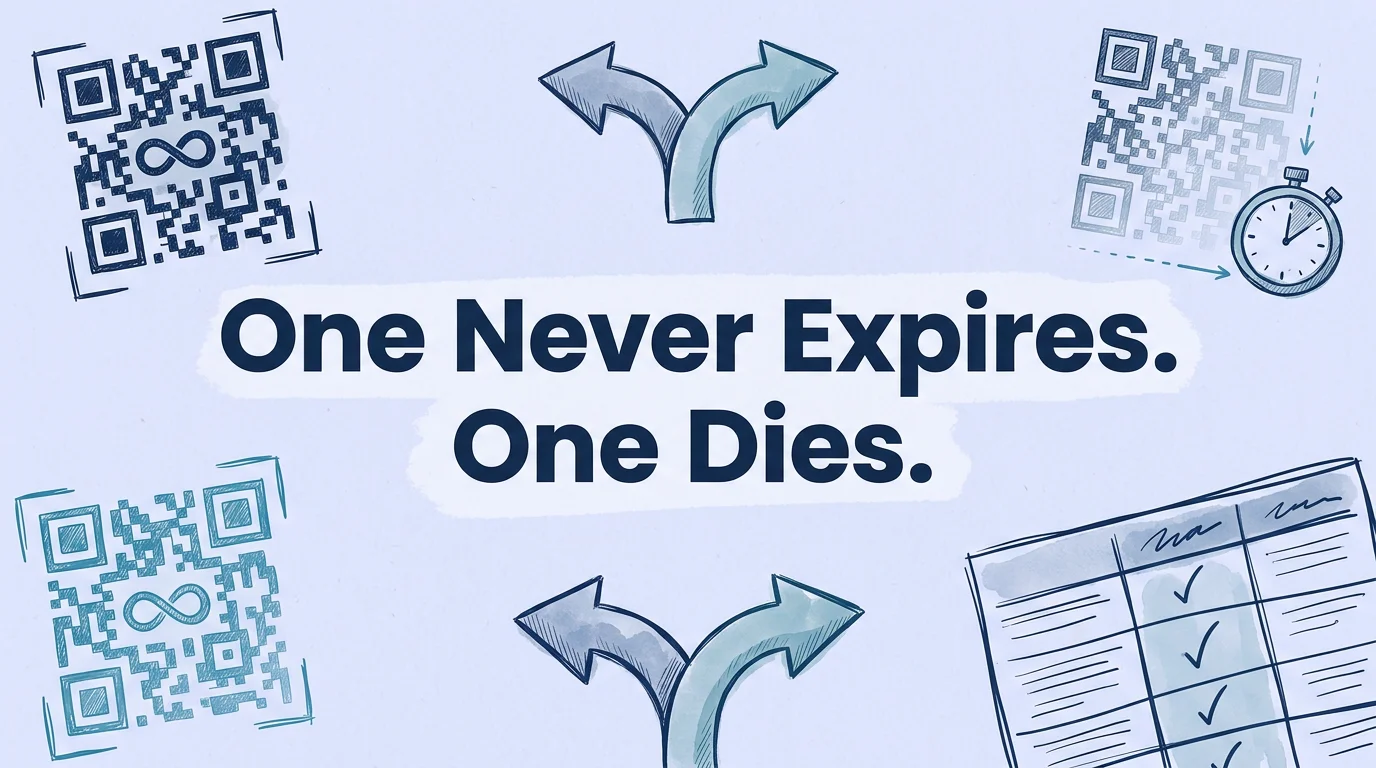
Most explanations of static vs dynamic QR codes either oversimplify ("static is permanent, dynamic is editable") or bury the practical implications in marketing copy for whichever platform is writing the post. Neither version tells you what you actually need to know before deciding. A static QR code encodes the destination directly into the image, permanent, free, no server required, never expires. A dynamic QR code encodes a redirect that lives on a platform's server, editable, trackable, but contingent on an active subscription, and dead the moment that subscription lapses on most platforms.
TL;DR
- Static QR codes encode data directly into the pattern, permanent, free, no expiration, no subscription, ever.
- Dynamic QR codes encode a redirect URL, editable and trackable, but tied to a platform that can deactivate the code if you stop paying.
- Most users for personal, small business, or one-time use cases don't need dynamic codes. The subscription upsell is real.
- The only scenario where dynamic codes are clearly worth it: you need to change the destination after printing physical materials at scale.

What is a static QR code?
Create your first QR code — free
Get startedA static QR code encodes data directly into its pixel pattern using the ISO/IEC 18004 standard. The encoded data, a URL, a phone number, a WiFi network's SSID and password, a vCard contact, is permanently baked into the arrangement of black and white modules in the code image. No server, no redirect layer, no account. Scanning a static QR code triggers a direct action: your device opens a browser to the URL, connects to the WiFi network, or imports the contact.
Because static codes have no server dependency, they're immune to the failure modes that affect dynamic codes. No subscription to lapse, no redirect server to go down, no scan cap to hit. A static QR code printed on a wine label in 2015 still works in 2026 if the destination URL is live. The code itself doesn't degrade, only the destination can become stale.
Static QR codes are also free to generate. Every platform, including QR Nova, generates unlimited static codes with no account required. The image is computed client-side from the data you provide and downloaded as a file. No ongoing cost because there's no ongoing server involvement.
What can a static QR code store?
- URLs: the most common use case. Any web address, including long URLs with parameters.
- WiFi credentials: SSID, password, and encryption type. Scanning connects the device to the network automatically.
- vCard contact information: name, phone, email, company, address. Scanning prompts the user to save the contact.
- Plain text: up to ~3KB of raw text.
- Email: pre-populated email with recipient, subject, and body.
- SMS: pre-populated text message to a phone number.
- Phone number: prompts the user to call.
- Geographic coordinates: opens in Maps app.
- Calendar events: vEvent format, prompts calendar import.
One trade-off: larger data payloads produce denser QR codes with smaller modules. A URL with heavy UTM parameters generates a visually busier code that requires a steadier camera and better lighting to scan reliably. For long URLs, shortening before encoding helps, though shortening doesn't make the code editable.
What is a dynamic QR code?
A dynamic QR code encodes a short URL, typically something like qrtiger.com/abc123, that points to a redirect server. The short URL is fixed and permanent in the code pattern. What's dynamic is the destination stored on the server: you can log into your platform dashboard and change where that short URL redirects, at any time, without changing the printed code.
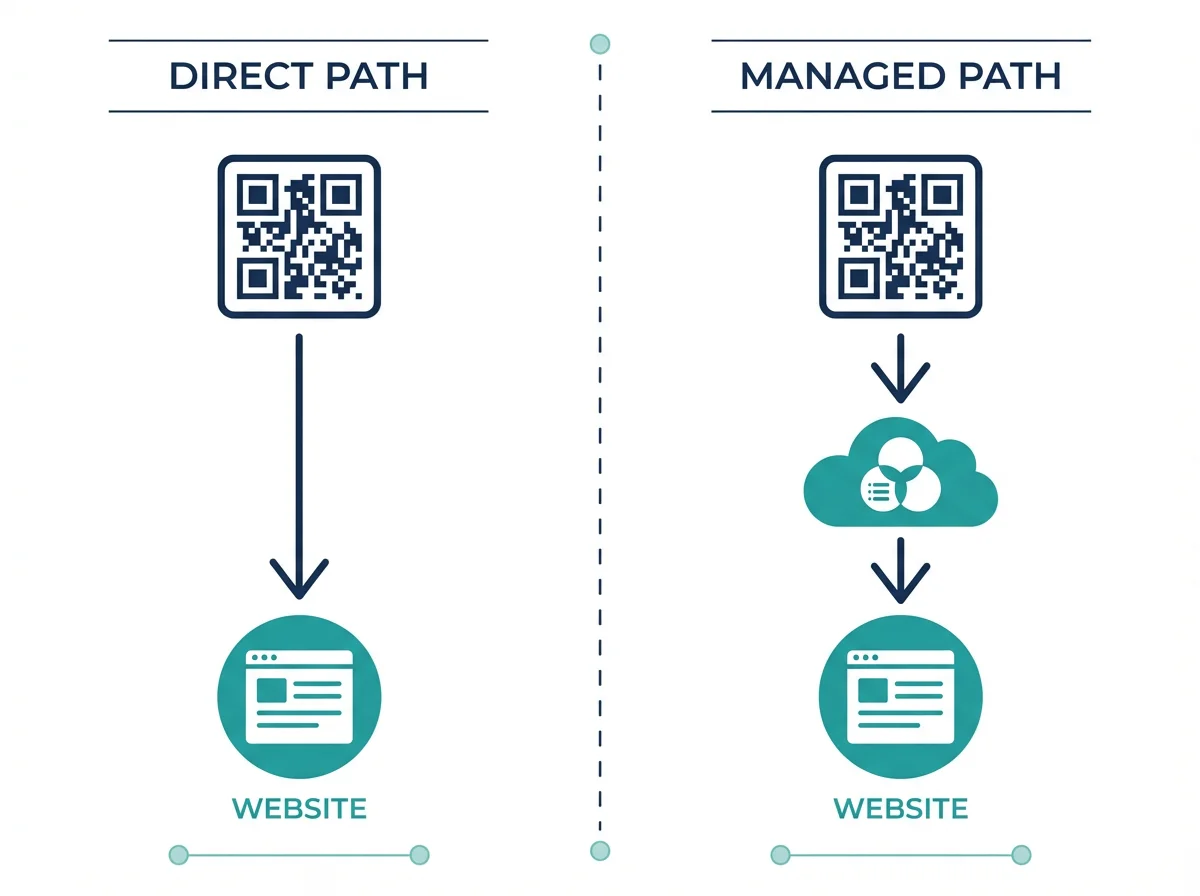
Our dedicated guide explains what a dynamic QR code is and how it works in full technical detail. This architecture enables three things that static codes cannot provide:
- Post-print editability: Change the destination URL after the code is printed. A retail chain prints 10,000 shelf labels with QR codes; they can point those codes at a summer campaign, then update them for the fall campaign, without touching a label.
- Scan analytics: Every scan is logged through the redirect server, capturing device type, operating system, approximate location (city/country level from IP), date, and time. This turns a physical QR code into a measurable marketing channel.
- Conditional routing: Advanced platforms support redirecting users based on geolocation, device language, time of day, or scan count. One printed code can send US users to a US landing page and UK users to a UK landing page.
The architectural cost is the server dependency. Every scan is a server request. If the server is down, the scan fails. If your account is deactivated, because your subscription lapsed, you hit a free tier cap, or you cancelled, the redirect stops working. Your printed materials become inert. This is the scenario that catches businesses off guard, and it's exactly why understanding whether QR codes expire before printing at scale matters.
Static vs dynamic QR codes: side-by-side comparison
| Property | Static QR Code | Dynamic QR Code |
|---|---|---|
| Destination editable after print | No | Yes |
| Scan analytics | No (UTM tracking only) | Yes, built-in |
| Server dependency | None | Yes (platform redirect server) |
| Expires | Never | On subscription lapse or scan cap |
| Cost | Free | Subscription required (most platforms) |
| Code size (data density) | Proportional to data length | Always small (short URL) |
| Works offline | Yes (code scans without internet) | No (redirect requires server) |
| Geolocation routing | No | Yes (advanced platforms) |
| A/B destination testing | No | Yes (advanced platforms) |
| Account required | No | Yes |
| Data portability risk | None | High (redirect rules locked to platform) |
When to use a static QR code
Static QR codes are the right choice for most real-world use cases. The decision tree is simple: if you know the destination won't change after printing, and you don't need granular scan analytics, a static code is cheaper, simpler, and permanent.
Low complexity: personal and small business use
A freelancer adds a QR code to their business card linking to their portfolio. A café prints table tents with a QR code to their WiFi network. A food truck prints a banner with a QR code to their menu PDF. A band puts a QR code on their merch linking to their latest album. In every one of these cases, the destination is known, stable, and unlikely to change on a tight timeline. Static codes are the right call, free to create, instant to download, permanent, no subscription risk. See how to create a QR code for the step-by-step process. WiFi QR codes and business card QR codes are both best implemented as static codes.
Mid complexity: event materials and product packaging
A conference prints 1,500 lanyards with QR codes linking to the event schedule page. The schedule URL is set before printing and won't change. A craft brewery puts QR codes on label backs linking to batch notes. A furniture retailer includes QR codes in the box linking to assembly instructions. These are all excellent static code use cases, the destination is known before print, it won't change during the material's lifespan, and there's no need to track individual scans.
High complexity: when static reaches its limit
A national retailer runs a multi-location campaign where the QR code destination needs to update when the promotion ends. A pharmaceutical company embeds QR codes in product packaging with a 3-year shelf life, needing to update the destination to always show current safety information. A logistics company needs scan data by location and time to audit delivery confirmation workflows. These are the cases where static codes genuinely fall short, and where dynamic codes are worth evaluating carefully.
When to use a dynamic QR code
Dynamic QR codes are clearly worth the complexity and cost in four specific scenarios:
1. the destination will change after printing
If you're printing at scale and there's any meaningful probability the URL will change during the material's lifespan, seasonal campaign, product line update, event schedule change, a dynamic code lets you update the destination without reprinting. For a 50,000-unit packaging run, the cost of reprinting due to a URL change far exceeds any dynamic code subscription.
2. you need granular scan analytics
Static codes can be tracked via UTM parameters in the destination URL, but only at the page-view level in your web analytics. Dynamic platforms give you device-level data: operating system, device type, country and city, scan time, total scan counts over time. For marketing attribution, proving a specific billboard or mail piece drove measurable traffic, this level of data is genuinely valuable.
3. you need geolocation or language-based routing
One code, printed once, routing users to different destinations based on their country or device language. This is a compelling capability for multi-market campaigns, international product packaging, or any scenario where a single physical code needs to serve multiple audiences without multiple codes cluttering the design.
4. you want to fix errors without reprinting
Static codes encode the URL permanently. Discover a typo or broken link after 20,000 flyers are printed and you're reprinting. A dynamic code lets you correct the destination in 30 seconds. This error-recovery capability alone can justify the subscription for large print runs.
The subscription trap — what most guides don't warn you about
Every major QR code platform that offers dynamic codes uses a subscription model. This creates a specific risk that doesn't exist with static codes: your printed materials become dependent on a recurring business relationship.
In practice, this plays out two ways:
Intentional cancellation: You run a campaign, decide you no longer need the platform, cancel your subscription, and discover six months later that every code you printed for that campaign returns an error. The physical materials are still out in the world, in customer hands, on product boxes, on signage, but the codes are dead.
Unintentional lapse: A credit card expires, a payment fails, a trial ends and auto-upgrade didn't trigger. The platform deactivates codes without warning. Customers start reporting that codes aren't working. By the time you find out, some customers have already written off the product or the business.
As of April 2026, QR Tiger's Starter plan at $7/month (annual) allows only 12 dynamic QR codes. Cancel and your account reverts to the free tier's 3-code limit, codes 4 through 12 are deactivated immediately. QR Code Generator Pro, which handles QR Code Monkey's dynamic offering, has similar terms. This is the industry standard: your physical materials are hostage to your subscription status.
The alternative worth knowing: QR Nova's dynamic codes stay active permanently, not contingent on an ongoing subscription. Walk away and the last destination you set stays active. Create a permanent QR code free at QR Nova.
The counterintuitive case against dynamic codes
Here's what most dynamic QR platform blogs won't tell you: the vast majority of QR code use cases don't actually benefit from dynamic codes.
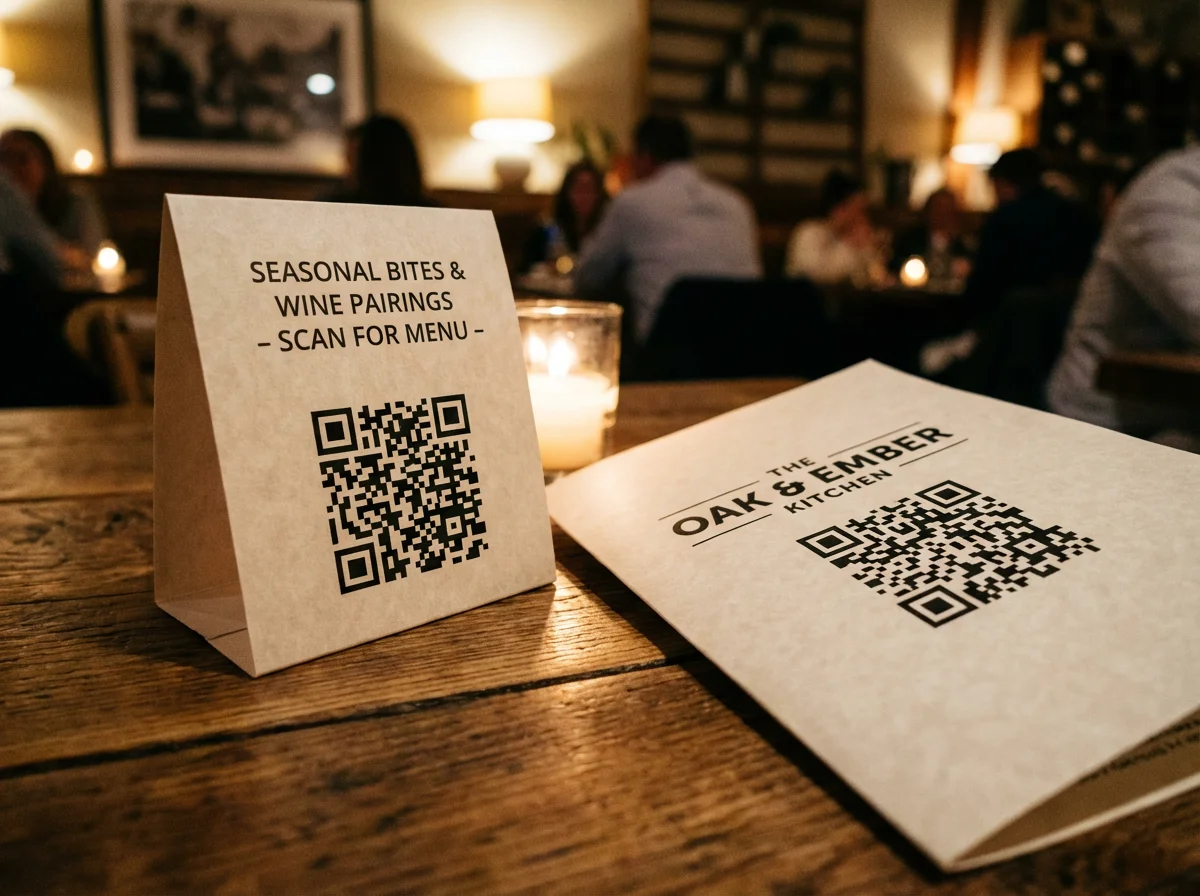
The "update the destination without reprinting" feature is compelling in theory. In practice, ask yourself: how often does the destination URL actually change? For a restaurant menu, the answer is usually never, the menu PDF is hosted at a stable URL, updated in place, and the QR code keeps pointing to the same address. For a business card, your LinkedIn URL isn't changing. For a product label, the product page URL is set for the product's lifecycle.
Scan analytics are genuinely useful for marketing campaigns. They're overkill for a table tent at a café. The restaurant owner doesn't need to know that 47 people scanned their WiFi QR code on a Tuesday between 2pm and 4pm, they just need the customers connected.
The subscription model works for platforms because the "you might need to update it" fear outweighs the actual frequency of needing to update it. Most users who pay for dynamic codes never update the destination after printing. They're paying for a capability they don't use, while accepting the risk of their codes dying if they ever cancel.
How to add analytics to a static QR code (without going dynamic)
If you need basic traffic measurement but not per-scan device data, UTM parameters give you meaningful visibility without a dynamic code subscription.
Instead of encoding https://yoursite.com/menu, encode https://yoursite.com/menu?utm_source=qr&utm_medium=print&utm_campaign=table-tent. Every visit from that QR code shows up in Google Analytics (or any UTM-aware analytics tool) as a distinct traffic source. You can create different UTM parameters for each printed location, table tent vs window poster vs takeaway bag, and track them separately.
Limitations: you don't get device type or exact geographic data, and you can't see scan counts separate from page loads (if a customer scans but closes before the page loads, the scan doesn't register). For full marketing attribution, a dynamic platform still provides richer data. But for 80% of small business use cases, UTM-tagged static codes are sufficient.
QR code size and data density
One technical advantage of dynamic codes that rarely gets mentioned: they always produce smaller, less dense QR patterns, because they only encode a short URL (usually 20-30 characters). A static code encoding a long URL with UTM parameters can produce a much denser pattern, which requires a better camera and more stable conditions to scan reliably.
In practice: if your destination URL is under 100 characters, static code density isn't a problem. If you're encoding a URL with extensive query parameters, or a vCard with multiple fields, the resulting static code will be denser and should be printed larger (minimum 3cm × 3cm rather than the standard 2cm minimum). Error correction level H, which allows the code to survive up to 30% physical damage, is recommended for any permanent installation, but it also increases density. Test your static codes at the intended print size before committing to a large run.
How QR nova approaches this
QR Nova generates both static and dynamic QR codes. For static codes, WiFi, vCard, URL, PDF, plain text, there's no account required, no subscription, and no expiration. The code is generated and downloaded immediately. WiFi QR codes and business card QR codes are the most common static use cases on the platform.
For dynamic codes, QR Nova's model differs from the subscription-trap norm: codes remain active permanently. If you never log in again after creating a dynamic code, the last destination you set keeps working. The redirect server doesn't deactivate your codes on cancellation, because permanence is the product, not a premium feature.
Once something is printed, you've lost control of how many copies exist. The responsible approach is to guarantee those codes keep working regardless of billing status.
You can create a permanent static or dynamic QR code free at QR Nova, no sign-up required for static types.
Frequently asked questions
What is the difference between static and dynamic QR codes?
A static QR code encodes the destination, a URL, phone number, WiFi credentials, or contact card, directly into the image pattern. The data cannot be changed after creation. A dynamic QR code encodes a short redirect URL that points to a platform's server; the actual destination is stored on that server and can be updated any time without changing or reprinting the code. Static codes are permanent and free; dynamic codes are flexible but require an active subscription on most platforms.
Which is better: static or dynamic QR codes?
Neither is universally better, it depends on whether the destination will change after printing and whether you need scan analytics. Static QR codes are better for permanent destinations (restaurant WiFi, contact cards, product pages that won't move). Dynamic QR codes are better for campaigns where you need to update content post-print or measure scan performance. Most users for personal and small business use never need dynamic codes.
Are dynamic QR codes more expensive than static?
Yes. Static QR codes are free to generate on virtually every platform, including QR Nova, with no scan limits and no ongoing cost. Dynamic QR codes require a subscription on most platforms, QR Tiger starts at $7/month, QR Code Generator Pro at $9.99/month. Some platforms like QR Nova offer dynamic codes that stay active permanently without requiring an ongoing subscription.
Can a static QR code be changed after printing?
No. A static QR code encodes the destination directly into the pixel pattern using the ISO/IEC 18004 standard. Changing the destination would require generating an entirely new code and reprinting all physical materials. If there's any chance the destination URL might change, a dynamic code is the better long-term choice.
Do dynamic QR codes expire?
Dynamic QR codes expire when the platform's subscription lapses or when a free tier scan cap is hit. QR Tiger's free dynamic codes stop redirecting after 500 total scans. On paid platforms, cancelling your subscription deactivates codes tied to your account. Static QR codes never expire, they have no server dependency.
Do dynamic QR codes need internet to work?
Yes. Every time someone scans a dynamic QR code, their device makes a request to the platform's redirect server, which then forwards them to the destination. If the platform's server is down or your account is deactivated, the redirect fails. Static QR codes also need internet to load the destination, but the QR code itself doesn't depend on any third-party server to function.
Can I track scans on a static QR code?
Not with the QR code itself. Static codes have no server layer, so no scan data is collected. However, you can add UTM parameters to the destination URL and track visits through Google Analytics or any web analytics tool. This gives you traffic data at the page level but not the granular per-scan data (device type, location, time) that dynamic platforms provide.
What kinds of data can a static QR code contain?
Static QR codes can encode URLs, plain text, email addresses, phone numbers, SMS messages, WiFi network credentials (SSID and password), vCard contact information, geographic coordinates, and calendar events. The limit is how much data fits in the QR code pattern, larger data payloads produce denser, harder-to-scan codes.
Related articles
How to Make a QR Code (Without It Failing at Print)
How to make a QR code that actually scans: static vs dynamic, error correction, testing before you print. Free, no sign-up.
How to Create a QR Code (2026): Complete Step-by-Step Guide
How to create a QR code in under 60 seconds, free, no sign-up, no subscription trap. Static codes that never expire, dynamic codes you actually own.
What Is a Dynamic QR Code? How It Works
What is a dynamic QR code? It's a code with an editable destination and scan analytics, but it comes with a subscription trap most guides skip.
Create your first QR code — free
Get started