What Is a Dynamic QR Code? How It Works
What is a dynamic QR code? It's a code with an editable destination and scan analytics, but it comes with a subscription trap most guides skip.
This article was written by the QR Nova team. We build QR code software, which may inform our perspective.
Every explanation of dynamic QR codes leads with the same two selling points, you can edit the destination and track scans, and stops there. What they skip is the third fact that determines whether a dynamic QR code is the right choice: on most platforms, the code dies the moment you stop paying. A dynamic QR code encodes a short redirect URL into its pattern; the actual destination lives on a platform's server and can be changed at any time, but it also stops working if your subscription lapses, which makes every physical material using that code dependent on a recurring billing relationship.
TL;DR
- A dynamic QR code stores the destination on a server, not in the code, enabling post-print edits and scan analytics.
- The code itself never changes; only the server-stored destination is updated.
- Most platforms deactivate dynamic codes when subscriptions lapse, printed materials become inert.
- QR Tiger's free plan caps dynamic codes at 500 scans. After that, the code stops redirecting.
What is a dynamic QR code?
Try it now — no sign-up needed
Get startedA dynamic QR code encodes a short redirect URL, typically a platform-generated slug like qrnova.io/r/abc123, directly into its pattern. When a user scans the code, their device sends a request to that short URL, which resolves to the platform's redirect server. The server looks up the destination you've configured in your account and returns an HTTP redirect to the actual URL. The user's browser follows the redirect and lands at the destination.
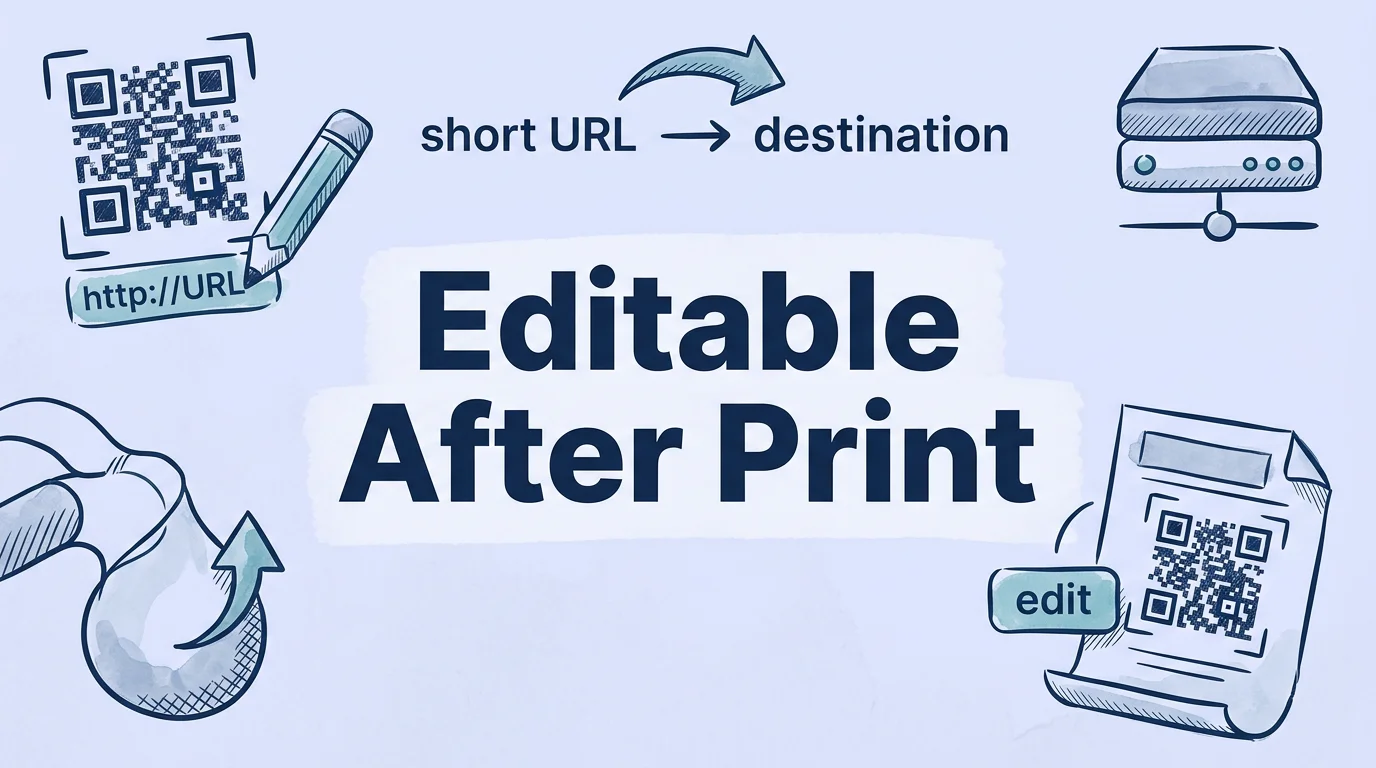
The distinction from a static QR code is architectural: the destination is stored on the server, not in the code. This means you can log into your dashboard and change the destination at any time, the printed code stays the same, but future scans go to the new URL. The physical code is permanent; the destination it points to is not.
This architecture also enables scan analytics. Every request to the redirect server is a logged event: timestamp, device type, operating system, approximate geographic location (derived from IP address), and total cumulative scan count. Because all scans pass through the platform's server, the platform can report on every single one.
How a dynamic QR code works, step by step
- You create a dynamic QR code on a platform and enter your destination URL (e.g.,
https://yoursite.com/summer-campaign). - The platform generates a short redirect URL (e.g.,
qrnova.io/r/abc123) and stores the destination in their database. - The short redirect URL is encoded into the QR code pattern and you download the code image.
- You print the QR code on flyers, packaging, posters, or business cards.
- A user scans the code. Their device reads the encoded short URL and opens a browser to
qrnova.io/r/abc123. - The platform's server receives the request, logs it with device metadata, and returns a 301/302 redirect to
https://yoursite.com/summer-campaign. - The user lands at the destination. The scan is logged in your analytics dashboard.
- When the campaign ends, you log in and update the destination to
https://yoursite.com. Every future scan of the same printed code now goes to the homepage, no reprinting needed.
That's the full cycle. The power is in step 8: one code, multiple destinations over time, without touching the printed materials.
What dynamic QR codes enable that static codes can't
Post-print editability
The most cited advantage. Print 10,000 shelf labels with a dynamic QR code today; update the destination when the promotion ends. Point it at the summer campaign for three months, then update to the fall campaign. If the destination URL changes due to a site migration, update it in your dashboard, nothing to reprint.
For large-format or high-volume print runs, this capability can pay for itself in reprinting costs avoided. A single reprint of 10,000 flyers at $200/1,000 is $2,000. A year of a dynamic QR platform subscription at $7–$37/month is $84–$444. The math works.
Scan analytics
Dynamic platforms log every scan with device type, operating system, country and city (from IP geolocation), scan date and time, and cumulative total. This turns a physical QR code into a measurable marketing channel. A poster campaign in three cities, each with a unique dynamic code, gives you per-location scan data that tells you which location drove the most engagement.
For marketing attribution, proving that a specific OOH placement, direct mail piece, or retail display drove measurable traffic, scan analytics are genuinely valuable. Our guide on how to track QR code scans covers the full analytics setup. According to data published by QRCodeKIT in early 2026, campaigns using dynamic QR codes with active analytics monitoring achieved 23% higher engagement rates than equivalent campaigns using static codes, primarily because teams used the scan data to optimize code placement and size.
Conditional routing
Advanced dynamic platforms support routing rules: redirect users to different destinations based on their country, device language, device type (iOS vs Android vs desktop), or time of day. One printed code, multiple audiences. This is particularly useful for international campaigns, multi-language materials, and time-sensitive promotions, redirect to the event livestream during the event, and to the recording after.
Error recovery without reprinting
You printed 5,000 brochures and discover the destination URL has a typo, it's /produts instead of /products. With a dynamic code, you fix the destination in your dashboard in under a minute. With a static code, you're reprinting all 5,000 brochures. This error-recovery case alone justifies dynamic codes for large print runs where the destination is set at the last minute.
The subscription dependency — what you need to know before printing
The redirect server that makes dynamic QR codes work is operated by the platform you used to create the code. That server incurs ongoing costs: infrastructure, bandwidth, and staff to maintain it. Platforms recover those costs through subscriptions.
The consequence: if your subscription lapses, whether from cancellation, payment failure, or trial expiry, most platforms deactivate the redirect. Every printed material using that code returns an error when scanned. The code image looks identical; the redirect just stops working.
This is not a hypothetical edge case. It's the designed revenue model. Platforms have calculated that the pain of deactivated codes motivates subscription renewal more effectively than any sales pitch. The printed materials are effectively held hostage.
Specific current policies, as of April 2026:
- QR Tiger: Free plan allows 3 dynamic codes with 500 total scans each. Exceeding the scan cap stops the redirect. Cancelling a paid plan reverts to free-tier limits; codes beyond the free allocation are deactivated immediately.
- Flowcode: Free tier allows 2 active dynamic codes. Creating more than 2 codes on the free tier may deactivate earlier ones. Paid plans maintain all codes within the plan's code limit.
- QR Code Generator Pro (powers QR Code Monkey's dynamic feature): Codes are deactivated on plan cancellation. No grace period documented in current terms.
Understanding whether your QR codes expire when you cancel is the most important question to ask before printing dynamic codes at scale.
When you don't need a dynamic QR code
This is the section that most dynamic QR platform blogs skip, for obvious reasons. The honest answer: most personal and small business use cases don't require dynamic codes.
You don't need dynamic codes if:
- The destination URL is stable and unlikely to change (a restaurant's menu URL, a contact card, a WiFi network's credentials).
- You don't need per-scan analytics and UTM parameters on the destination URL are sufficient for your tracking needs.
- You're printing a small quantity where reprinting, if needed, is low cost.
- The materials are for personal use: business cards, event invitations, personal portfolios.
- You want the codes to work permanently without ongoing cost or billing relationships.
For all these cases, static QR codes, which encode the destination directly, have no server dependency, and never expire, are the right tool. The full static vs dynamic QR code comparison walks through every dimension of this decision.
You do need dynamic codes if:
- You're printing at scale and there's a realistic probability the destination will need to change during the materials' lifespan.
- You need granular per-scan analytics for campaign measurement or ROI reporting.
- You need geolocation or language-based routing from a single printed code.
- You want error-recovery capability for large print runs.
Examples at three levels
Low: the freelancer's business card
A designer puts a QR code on their business card linking to their portfolio at yourname.com/portfolio. The portfolio URL is stable, it's tied to their personal domain. They hand out maybe 200 cards over two years. A static QR code is the right choice: free, permanent, no subscription, no risk of expiring in someone's wallet. If the portfolio URL changes (unlikely), they reprint the cards, a $30 problem. No dynamic code needed.
Mid: the seasonal retail campaign
A regional clothing retailer runs a summer sale campaign with QR codes on 2,000 in-store shelf edge labels pointing to /summer-sale. The campaign runs for 8 weeks. When the campaign ends, they need the codes to stop pointing to a dead page. A dynamic code lets them update the destination to the main site homepage without replacing 2,000 shelf labels. Scan analytics tell them which store locations drove the most scans. A $7–$16/month subscription is clearly justified by the reprint cost avoided and the analytics value.
High: enterprise product packaging
A national consumer goods brand embeds QR codes in product packaging for a 3-year print run of 500,000 units. Requirements: update the destination when safety information changes, route users to localized content based on their country, track scan volume by product SKU and region, and guarantee code functionality for the full product lifecycle regardless of platform contract changes. This requires a dynamic code platform with enterprise SLA, contractual uptime guarantees, and data portability, the ability to export redirect rules and migrate to a different platform if needed. The platform choice is a vendor relationship, not just a tool subscription.
How to create a dynamic QR code that won't hold you hostage
If you've determined that dynamic codes are the right choice for your use case, the platform selection question is: what happens to my codes if I stop paying, and can I export my redirect rules if I need to migrate?
Most platforms will tell you their codes are "deactivated" on cancellation. That's the industry default. A few platforms have built subscription-independent permanence into their model.
QR Nova's dynamic codes stay active permanently, the last destination you configured continues redirecting regardless of account status. This matters for physical materials that will be in circulation for months or years. Create a dynamic QR code at QR Nova, no subscription required to keep it alive.
If you're already using a platform that does deactivate on cancellation, the practical mitigation is: before cancelling, update all your dynamic code destinations to a URL you control, then keep a record of all code short URLs. If you ever need to restore functionality, at minimum you know where each code was pointing.
Frequently asked questions
What is a dynamic QR code?
A dynamic QR code encodes a short redirect URL into its pattern. When scanned, the user's device hits a platform's redirect server, which forwards them to the actual destination. The destination is stored on the server, not in the code, so it can be updated at any time without changing the printed code. This enables post-print editability and scan analytics.
What is the difference between a static and dynamic QR code?
A static QR code encodes the destination directly into its pixel pattern, permanent, no server needed, never expires. A dynamic QR code encodes a short URL that redirects through a platform server, editable and trackable, but dependent on an active subscription on most platforms. Static codes are free and permanent; dynamic codes are flexible but carry subscription risk.
Do dynamic QR codes expire?
Dynamic QR codes expire when the platform's subscription lapses or when a free tier scan cap is reached. On QR Tiger's free plan, codes stop redirecting after 500 total scans. Cancelling a paid subscription on most platforms deactivates all dynamic codes tied to that account. A few platforms, including QR Nova, keep codes active permanently regardless of subscription status.
Can I track who scanned my QR code?
Dynamic QR code platforms provide scan analytics including total scan count, date and time of each scan, device type and operating system, and approximate geographic location (country and city from IP address). You cannot identify individual users by name, QR code scans are anonymous, like a standard web page visit. GDPR and CCPA do apply to scan data collection if you operate in those jurisdictions.
How do I make a dynamic QR code?
Create an account on a dynamic QR code platform, enter your destination URL, and generate the code. The platform creates a short redirect URL, encodes it into a QR code image, and stores your destination URL on their server. You download the code image and can update the destination in your dashboard at any time. For codes that stay active permanently without a subscription, use QR Nova.
What can a dynamic QR code link to?
Any URL, websites, landing pages, PDF documents, video files, app store pages, social media profiles, or any internet-accessible resource. Advanced dynamic platforms also support native content types: restaurant menu layouts, digital business cards (vCard Plus), social media aggregator pages, file download pages, and event information pages, all rendered by the platform without requiring an external website.
Are dynamic QR codes safe?
Dynamic QR codes carry an elevated phishing risk compared to static codes, because the destination can be changed after the code is printed without the code itself changing. A code that pointed to a legitimate site could be redirected to a malicious site by whoever controls the platform account. This risk is manageable: use trusted platforms, verify the domain in your browser bar after scanning, and be cautious scanning codes in unexpected locations.
Related articles
How to Make a QR Code (Without It Failing at Print)
How to make a QR code that actually scans: static vs dynamic, error correction, testing before you print. Free, no sign-up.
Can You Edit a QR Code After Printing?
Can I edit a QR code after printing it? Static codes can't, but dynamic codes let you change the destination anytime. Here's exactly how it works.
How to Create a QR Code (2026): Complete Step-by-Step Guide
How to create a QR code in under 60 seconds, free, no sign-up, no subscription trap. Static codes that never expire, dynamic codes you actually own.
Try it now — no sign-up needed
Get started