How Much Does a QR Code Cost in 2026? Full Breakdown
How much does a QR code cost? Static codes are free. Dynamic codes run $5–$89/month. Full price breakdown with hidden cost warnings. No fluff.
This article was written by the QR Nova team. We build QR code software, which may inform our perspective.
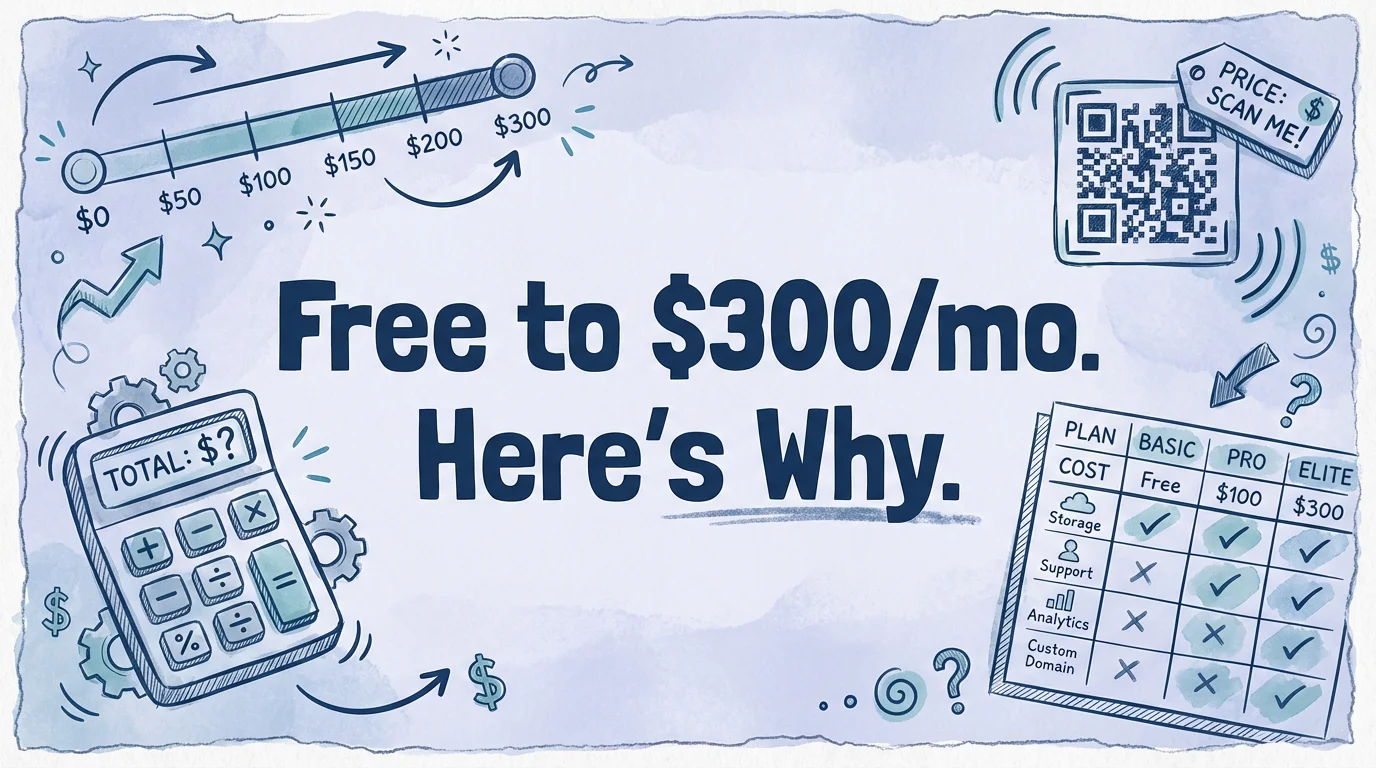
Most "how much does a QR code cost" articles give you a range like "$0 to $500/month" and call it a day. That's technically accurate and completely useless for making a decision. The range is that wide because the question conflates two fundamentally different products: static QR codes (free, forever) and dynamic QR codes (subscription-based, with a range that reflects infrastructure and analytics features). Here's what those categories actually cost, where the hidden costs are, and when paying is actually worth it. Static QR codes cost exactly $0. Dynamic QR codes cost between $5/month and $89+/month depending on code volume and features. The "cost" of choosing the wrong type is higher than either: printed materials that break when you cancel your subscription.
TL;DR
- Static QR codes: free from every generator. No exceptions. No subscription required. Never expire.
- Dynamic QR codes: $5–$89/month depending on volume, analytics, and team features.
- Hidden cost to watch: scan caps on free/cheap tiers (QR Tiger free tier caps at 500 scans per code).
- Long-term cheapest: static codes when destination is stable, or a lifetime dynamic plan for changing destinations.
How much does a QR code cost? the actual answer
Generate your first QR code — free
Get startedA QR code is free to generate. Every reputable generator, QR Code Monkey, QR Nova, Adobe Express, Canva, produces static QR codes at zero cost with no account required. This is the baseline. Paying for QR code generation is optional, not mandatory.
The cost discussion starts when you add features that require server infrastructure: editable destinations (dynamic QR codes), scan analytics, and custom domain short URLs. These require ongoing compute, storage, and maintenance that platforms charge for. The subscription is not a feature tax, it's infrastructure cost passed to the user.
Static QR code cost: $0
Static QR codes encode a URL, WiFi credential, contact card, or other data directly in the pixel pattern using the ISO/IEC 18004 standard. No server. No subscription. No account. The code is generated locally in your browser or on the generator's server and then downloaded. After that, the platform has no further role in the code's operation.
Static codes work indefinitely as long as:
- The physical print is readable (not too small, not damaged, sufficient contrast)
- The destination URL is still live
For a restaurant pointing to a permanent menu URL, a business card pointing to a LinkedIn profile, a WiFi setup QR code, static costs $0 and works for the physical life of the print material.
You can generate a static QR code at QR Nova right now, no account required. The code is yours immediately, in any format you need for print or digital use.
Dynamic QR code cost: $5–$89/month
Dynamic QR codes encode a short redirect URL that routes through the platform's servers. The platform stores the mapping between the short URL and your actual destination. This infrastructure is what you pay for monthly.
Entry-tier pricing (as of April 2026)
Beaconstac Lite: $5/month (annual billing, $60/year). 3 dynamic QR codes, unlimited scans, basic analytics. No scan cap. This is the cheapest subscription in the market for dynamic codes with truly unlimited scans. Beaconstac's free trial is 14 days, any codes created during the trial deactivate if you don't upgrade.
QR Tiger Starter: $7/month (annual billing). 3 dynamic codes with unlimited scans. The free tier (before any payment) caps dynamic codes at 500 scans each, a limitation that trips up users who use the free tier for public-facing codes.
Uniqode Starter: $15/month. 5 dynamic codes, basic analytics, standard support. Positioned above Beaconstac's entry point without significant feature differentiation at this tier.
Mid-range pricing
QR Tiger Advanced: $16/month (annual). 10 dynamic codes, unlimited scans, advanced analytics including geographic data and device breakdown. At this tier, analytics become genuinely useful for campaign measurement.
Flowcode Pro: $25/month. 50 dynamic codes, 6,000 scan analytics. Flowcode's pricing structure is notable: the jump from free (2 codes) to Pro ($25/month) is steep, with no intermediate tier. If you need 5-10 codes, you're forced into the $25/month tier.
QR Code Generator (Beaconstac) Pro: $30–$45/month depending on code volume. Includes white-labeling, custom domains, and team access.
Professional pricing
QR Tiger Professional: $37/month (annual). 25 dynamic codes, all analytics features, custom domain short URLs, and API access. The custom domain feature is significant: instead of qrtg.io/abc123, your short URL uses your brand domain. This matters for brand trust, scanners see your domain in the URL preview.
Bitly QR: $35/month and up. Bitly's pricing reflects their full link management product, not just QR codes. For QR code-only use cases, this is among the highest cost-to-value ratios in the market. Bitly is only cost-effective if you're already paying for link management and the QR feature is incidental.
Enterprise pricing
QR Tiger Enterprise: $89/month (annual). Unlimited codes, unlimited scans, custom domain, API, team management, SSO, and dedicated support. The enterprise tier is for national-scale campaigns, product packaging, and retail operations where code volume is high and uptime guarantees matter.
Flowcode Enterprise: $250/month+. Includes CRM integrations, API, advanced security, and dedicated account management. Primarily serves large consumer brands doing omnichannel campaigns.
Uniqode Team/Enterprise: $60–$200+/month depending on negotiated terms. Targets mid-market marketing teams.
The hidden costs nobody mentions
Scan limits on cheap tiers
The most common hidden cost trap: a platform advertises "free dynamic QR codes" without prominently disclosing the scan cap. QR Tiger's free tier caps each dynamic code at 500 total scans. Once a code hits that cap, it stops redirecting. For internal use cases (a QR code on an office WiFi sign, scanned by 30 employees), 500 scans is practically unlimited. For a QR code on a restaurant table card in a busy location, 500 scans lasts about a week. After that, every customer who scans the code during service gets an error.
In March 2026, a North Penn Now investigation documented small businesses whose QR codes went dead without warning, a significant proportion were free-tier codes that hit scan caps, not subscription cancellations. The effect from the customer side is identical: the code doesn't work.
The subscription renewal risk
Dynamic QR codes are only active while the subscription is current. Miss a payment, cancel to cut costs, or let a credit card expire, and all your printed codes go dead simultaneously. If those codes are on product packaging that's been in distribution for six months, there's no recall option. The subscription cost is a permanent operational commitment for the life of the physical materials.
This is the most significant hidden cost: the total subscription payment over the lifecycle of your printed materials. A set of restaurant table cards replaced every 18 months costs $90 in Beaconstac subscriptions (18 months × $5/month) on top of the printing cost. That's the real cost of choosing dynamic over static for a use case that doesn't need it.
Per-code costs at scale
Most starter plans include 3-5 dynamic codes. If your business needs 50+ codes, a retail chain, a large event, a multi-product company, the per-code cost on cheap tiers is prohibitive. At QR Tiger's $7/month for 3 codes, 50 codes requires enterprise pricing. Always calculate cost per code at your actual volume, not the advertised per-plan cost.
Dynamic QR code cost vs. static QR code cost — the real comparison
The question "how much do dynamic QR codes cost" usually comes from someone who assumes they need dynamic. Before paying, verify that assumption:
Use case: stable URL, no need for editing
Restaurant linking to a permanent menu page. Business card linking to a website. Retail product linking to a product page. Event flyer linking to the event registration page (URL won't change after printing).
Static cost: $0. Dynamic cost: $60–$180+/year. Difference in user experience: zero. The customer scans and lands on the same page either way. Paying for dynamic in this case is waste.
Use case: URL will change post-print
Campaign landing page that will be updated after launch. Seasonal menu that changes quarterly. Product that will have multiple regional variants. Conference badge linking to a session schedule that changes.
Static cost: $0 initially, plus reprint cost every time the URL changes. Dynamic cost: $60+/year with no reprinting needed. At some reprint frequency, dynamic pays for itself. The break-even point is roughly: if you'd reprint more than 2-3 times per year, a dynamic subscription is cheaper than the reprint costs.
Use case: scan analytics required
Marketing campaign measuring QR code ROI. Retail location tracking by store. Multi-location campaign comparing engagement.
Static cost: $0 (but zero analytics, you have no data). Dynamic cost: $5–$37/month depending on analytics depth needed. Analytics have real business value. A campaign that cost $5,000 to print benefits from $60/year in analytics to know if the investment worked.
When paying for a QR code is worth it
Pay for a dynamic QR code subscription when:
- Your destination URL will change post-print at least 2-3 times per year
- You need scan analytics for campaign ROI measurement
- You're running a multi-location campaign and need scan data segmented by location
- Your print materials have a long lifecycle (12+ months) and the URL may change in that time
- You need the ability to redirect to an error page or updated content if the original destination goes down
Don't pay when:
- Your destination URL is stable (homepage, permanent product page, stable menu URL)
- You need one code for a one-time event (static is correct, the code going 404 after the event is the expected behavior)
- You're creating a WiFi, vCard, or contact-type QR code (these encode static data by nature)
- You're testing whether QR codes work for your use case (test with static, switch to dynamic once validated)
How QR nova fits into the pricing landscape
QR Nova generates static QR codes, URL, WiFi, vCard, PDF, multi-link, free with no account, no sign-up, and no expiration. The code you generate is yours immediately, downloadable in print-quality formats, and functional indefinitely.
For the majority of QR code use cases, this is the correct product and the correct price point ($0). You can create a permanent QR code right now without creating an account.
For dynamic codes: the subscription model that most platforms use creates a permanent operational cost tied to your physical materials. QR Nova's position is that codes should not be held hostage to subscriptions, codes should remain active because the user created them, not because they're current on a recurring payment. If you do need dynamic features, evaluate the platform's policy on what happens to your codes if you ever cancel, ask it directly before printing at scale.
The answer to "how much does a QR code cost" is: $0 for static (the right answer for most use cases), $5–$89/month for dynamic (required only when the destination will change or analytics are needed), and potentially much more if you choose the wrong type for your situation and end up reprinting materials mid-campaign. For a side-by-side breakdown of every major platform's rates, see our QR code generator pricing comparison.
Frequently asked questions
How much does a QR code cost to create?
Static QR codes cost nothing to create, every major generator offers them free. Dynamic QR codes require a subscription: cheapest is around $5/month (Beaconstac Lite) for 3 codes with unlimited scans. Most professional plans run $7–$89/month depending on number of codes, analytics depth, and team features.
How much do dynamic QR codes cost?
Dynamic QR code subscriptions range from $5/month (Beaconstac Lite, 3 codes) to $89/month (QR Tiger enterprise). Mid-range plans at $15–$35/month cover 10–50 codes with analytics and basic customization. Enterprise pricing above $100/month typically includes custom domains, API access, SSO, and team management.
Are there any truly free QR codes that never expire?
Yes, static QR codes. They're free from every major generator and never expire because they have no server dependency. The code works as long as the destination URL is live. QR Nova generates static codes free with no account, no sign-up, and no expiration.
Why do some platforms charge for QR codes when others are free?
Free generators offer static codes, which require no server infrastructure after generation. Paid platforms offer dynamic codes, which route through redirect servers that cost money to run. Analytics storage, short URL management, and infrastructure reliability all cost money. The subscription is infrastructure cost, not a feature charge.
Is there a one-time payment option for QR codes instead of monthly?
QR Code Monkey offers a Lifetime Premium plan as a one-time purchase. Some smaller platforms offer lifetime deals. QR Nova's static codes are inherently 'one-time', generate once, no ongoing cost ever. For dynamic codes with editable destinations, lifetime plans are rare but exist and are the cheapest option long-term.
What does enterprise QR code pricing look like?
Enterprise plans (QR Tiger Pro at $89/month, Uniqode Team at $60–$200/month, Flowcode at $250+/month for enterprise) include custom domains for the short URL, SSO and team access controls, API access for bulk generation, CRM integrations, dedicated account support, and SLA guarantees on redirect uptime.
Do I need to keep paying to keep my QR code working?
For dynamic QR codes on most platforms: yes. Cancelling the subscription deactivates the redirect, breaking all printed codes. For static QR codes: no. There's nothing to pay, the code works indefinitely regardless of any account status because it has no server dependency.
Is paying for a QR code generator worth it for small businesses?
It depends on whether you need dynamic features (editable destination, scan analytics). If your QR codes point to stable URLs that won't change, free static codes provide identical functionality at zero cost. If you need to update destinations without reprinting, or if you need scan data for campaign measurement, a $5–$15/month dynamic plan pays for itself quickly.
Related articles
QR Code Generator Comparison (2026): Features Side by Side
QR code generator comparison for 2026: static codes, scan limits, expiry, pricing, and SVG export across QR Nova, QR Tiger, Uniqode, Flowcode, and Bitly.
Cheapest QR Code Generator: 2026 Pricing Compared (7 Tools)
Cheapest QR code generator compared: QR Tiger, Bitly, Flowcode, Uniqode & more. Real monthly cost, hidden fees, and one $0 no-subscription option.
Cheapest QR Code Generator: Real Price Breakdown
Cheapest QR code generator? Static codes are free everywhere. Dynamic codes start at $5/mo, but the real cost hides in scan limits. Full comparison.
Generate your first QR code — free
Get started