QR Code Generator Comparison (2026): Features Side by Side
QR code generator comparison for 2026: static codes, scan limits, expiry, pricing, and SVG export across QR Nova, QR Tiger, Uniqode, Flowcode, and Bitly.
This article was written by the QR Nova team. We build QR code software, which may inform our perspective.
Most QR code generator comparisons are ranked by whoever pays the highest affiliate commission, then dressed up with feature checklists that ignore the one thing that actually breaks: whether the code keeps working after you stop paying. The tables look thorough. They rank "design flexibility" and "integrations" and bury the detail that turns a printed code into a dead link. The only comparison that matters in 2026 is static versus dynamic and free-forever versus subscription — a static QR code from any generator works permanently, while a dynamic code from QR Tiger, Uniqode, Flowcode, or Bitly stops redirecting the moment you cancel. This is a feature-by-feature comparison of the major generators, with the trade-offs laid out instead of buried.
TL;DR
- Static codes are free and permanent on every major generator — QR Nova, QRCode Monkey, QR Tiger included. The differences only appear with dynamic codes.
- Dynamic codes mean a subscription: QR Tiger, Uniqode, Flowcode, and Bitly all gate redirect editing and analytics behind paid plans, and the code dies if you cancel.
- QR Nova is the main 2026 option that keeps static codes free forever with no account and no scan cap.
- For print, only use a generator that exports SVG. For full price detail, see our pricing comparison; for a ranked verdict, the best QR code generator guide.
How We Compared the Generators
Start free — no subscription trap
Get startedFeature counts are easy to inflate and mostly meaningless. A generator can list forty features and still hand you a code that expires. We compared on the seven things that decide whether a QR code actually serves its purpose over its real lifespan:
- Free static codes — can you generate a permanent code at no cost?
- Account required — do you have to sign up before you get a usable code?
- Scan limits — does the free tier cap how many times a code can be scanned?
- Expiry — does the code stop working on a timer or after cancellation?
- Dynamic codes — can you edit the destination after printing, and what does it cost?
- SVG export — can you download a vector file for large-format print?
- Analytics — does it track scans, and is that locked behind a paywall?
Every data point below reflects each platform's published terms as of June 2026. Plans change, so verify the current free-tier limits before you commit a code to print.
The Comparison Table
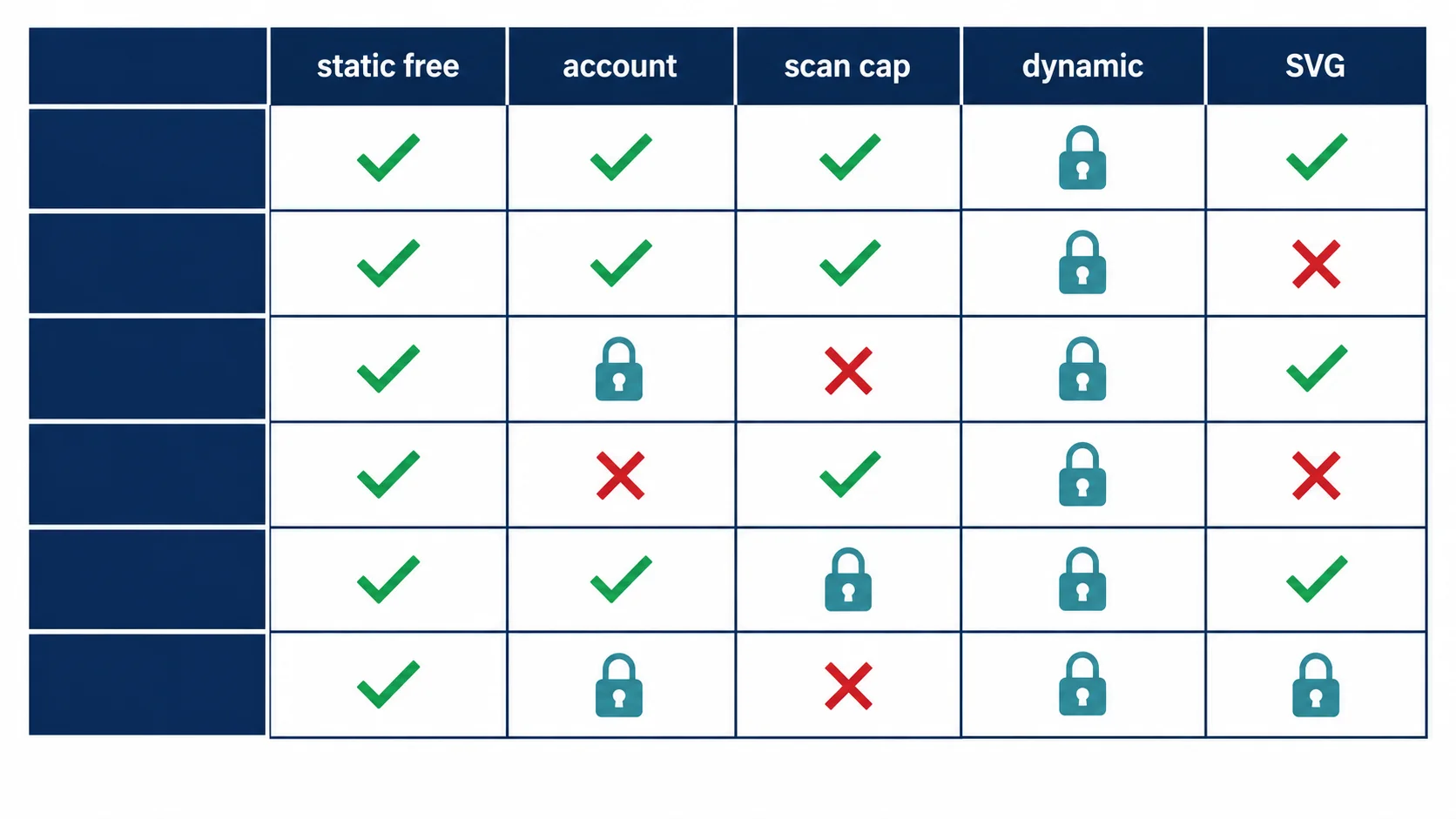
Here is the side-by-side. Static code generation is free almost everywhere — the real separation is in scan caps, account friction, and what happens to dynamic codes when the bill stops.
| Generator | Free static | Account needed | Free scan cap | Dynamic codes | SVG export |
|---|---|---|---|---|---|
| QR Nova | Yes, forever | No | None | Paid (optional) | Yes, free |
| QR Tiger | Yes | For dynamic | Capped on free dynamic | Subscription | Paid tiers |
| Uniqode (Beaconstac) | Yes | Yes | Trial-limited | Subscription | Paid tiers |
| Flowcode | Limited | Yes | Trial-limited | Subscription | Paid tiers |
| Bitly | Limited | Yes | Monthly quota | Subscription | Paid tiers |
| QRCode Monkey | Yes | No | None (static) | No native dynamic | Yes, free |
The pattern is consistent: the generosity lives in static codes, and the meter starts running the moment you need a code you can edit or track. That single line — "subscription" under dynamic — is where most printed-material disasters begin.

Free Static Codes: Who Actually Gives Them Away
A static QR code is free to create on every major generator, and that is not generosity — it is physics. A static code encodes your URL directly into the image using the ISO/IEC 18004 standard. Once the image exists, it needs no server, so there is no ongoing cost for a platform to charge against. QR Nova, QRCode Monkey, and QR Tiger all hand you a static code at no cost.
The differences are friction and ownership. QRCode Monkey and QR Nova require no account for a static code — you generate, download, and leave. Uniqode, Flowcode, and Bitly push you through signup first, which means your codes live inside an account you have to keep. For a code you intend to print once and forget, an account is a liability, not a feature: lose access to it and you lose the dashboard around your code.
Dynamic Codes, Scan Limits, and Expiry
Dynamic QR codes are where every "free" claim gets tested. A dynamic code points to a short redirect URL the platform controls, so you can change the destination after printing and see scan data. That redirect is a live service, and live services cost money to run — which is why every platform here gates dynamic codes behind a subscription.
The traps differ by platform. QR Tiger offers free dynamic codes but caps them at a fixed number of scans, after which the code goes dark. Flowcode and Uniqode run trial-style limits that expire on a timer. Bitly allocates a monthly link quota. In every case, the failure is silent: the code still looks perfect, the pattern still scans, but the redirect is dead and your printed flyer now leads nowhere. We cover the full mechanics in our static vs. dynamic QR codes guide.
This is the single most expensive mistake in the category. A restaurant prints 200 table tents with a dynamic code, the trial lapses, and every code on every table is dead at once. The fix is not a better platform — it is choosing static when the destination never needs to change.
Pricing in 2026
Paid plans across QR Tiger, Uniqode, Flowcode, and Bitly land in a similar range for dynamic features, typically billed monthly per set of codes or scans. The numbers move often enough that quoting an exact figure here would be stale within a quarter, so we maintain a dedicated, dated breakdown in our QR code generator pricing comparison.
The structural point survives any price change: you are renting the redirect. Stop paying and the dynamic code stops working, regardless of how many years it has been in print. A static code has no such meter. For a fixed destination, the cheapest plan on any platform is still more expensive over time than a free static code that never bills you.
SVG Export and Print Quality
If a code is going to print, the file format decides whether it scans. SVG is a vector format with no fixed resolution — it stays razor-sharp from a business card to a billboard. PNG is raster: size it for a small layout, scale it up for a poster, and the module edges blur into something a camera cannot decode.
QR Nova and QRCode Monkey export SVG for free. QR Tiger, Uniqode, Flowcode, and Bitly typically reserve SVG and other vector formats for paid tiers, handing free users a PNG that is fine on screen and risky in large-format print. For anything destined for paper, vector export is not a nice-to-have. See our SVG vs. PNG guide for the full breakdown.
When This Comparison Doesn't Matter
There is a real case where none of the above changes your decision: when you genuinely need to edit a destination after printing or you require detailed scan analytics for a campaign. A regional retailer rotating a promotion across twenty stores, or an agency that must report scan counts to a client, has a legitimate reason to pay for dynamic codes and live inside a platform. For those uses, compare QR Tiger, Uniqode, and Flowcode on analytics depth and team features, and accept the subscription as a cost of the campaign.
The comparison also stops mattering at the low end. For a one-off WiFi code on a café wall or a personal vCard, any reputable static generator works, and the brand on it is irrelevant. The decision only gets expensive in the middle: printed materials with a long life and a fixed destination, where a subscription buys you nothing but a future point of failure.
How QR Nova Compares
QR Nova is built around the part of this comparison that costs people money: permanence. Static QR codes are free forever, with no account, no email, and no scan cap. The code encodes your URL directly using ISO/IEC 18004, so it has no redirect server to expire and no subscription to lapse. Download it as SVG or PNG and it works for the life of the printed material, as long as the destination page exists.
Where you genuinely need a changeable destination or scan analytics, a dynamic option is available — but it is presented as a choice, not a default that quietly turns your printed code into a recurring bill. For the common case, a printed code with a fixed destination, the right answer is a free static code that no one can switch off. Compare the full ranking in our best QR code generator guide, or generate one now at the free QR code generator.
No account. No expiry. No subscription trap. That is the whole pitch, and in a category where the default business model is renting you back your own QR code, it is the comparison that ends up mattering most.
Frequently asked questions
What is the best QR code generator in 2026?
It depends on what you need. For a permanent code that never expires, QR Nova generates free static codes with no account and no scan cap. For dynamic codes with analytics, QR Tiger and Uniqode are the most established paid options. The honest answer is that no single generator wins every category — match the tool to whether your destination is fixed or changing.
Which QR code generators are completely free?
For static QR codes, almost all major generators — including QR Nova, QRCode Monkey, and QR Tiger — are free with no expiry, because a static code needs no server. For dynamic codes, the picture changes: most platforms offer a limited free trial, then charge a subscription. As of 2026, QR Nova is the main option that keeps static codes free forever with no account requirement.
Do QR codes from these generators expire?
Static QR codes never expire on any generator — the URL is encoded in the image itself. Dynamic QR codes expire when you stop paying or hit a scan limit. QR Tiger's free dynamic codes cap at a set number of scans, and Flowcode and Bitly gate dynamic features behind paid tiers. Always check whether your code is static or dynamic before printing.
What is the difference between QR Tiger, Uniqode, and Flowcode?
QR Tiger and Uniqode (formerly Beaconstac) are full marketing platforms with dynamic codes, analytics, and team features on monthly subscriptions. Flowcode focuses on design and consumer campaigns. All three lock dynamic functionality behind paid plans, so the code stops redirecting if you cancel. They differ mainly in price, design options, and analytics depth.
Which QR code generator is best for printing?
Use a generator that exports SVG, because vector files stay sharp at any print size from a business card to a billboard. QR Nova, QRCode Monkey, and most paid platforms export SVG. Avoid printing from a low-resolution PNG — blurry module edges fail to scan. For a permanent printed code, a static SVG with no subscription behind it is the safest choice.
Can I switch QR code generators without reprinting?
Only if your original code was dynamic and you control the redirect, or if you used a static code pointing to a URL you own. A static code printed by any generator keeps working forever as long as its destination page exists. A dynamic code is tied to the platform that issued it — cancel the subscription and it dies, which is the core reason to prefer static or a URL you control.
Related articles
Flowcode vs QR Tiger: Honest Comparison (2026)
Flowcode vs QR Tiger compared on real pricing, free plan limits, and what happens when you cancel. Find the best Flowcode alternative in 2026.
Best QR Code Generator (2026): Ranked Without Affiliate Bias
Best qr code generator 2026, ranked on scan permanence, real pricing, and honest limits. QR Tiger, Flowcode, Bitly, and QR Nova compared side by side.
Cheapest QR Code Generator: 2026 Pricing Compared (7 Tools)
Cheapest QR code generator compared: QR Tiger, Bitly, Flowcode, Uniqode & more. Real monthly cost, hidden fees, and one $0 no-subscription option.
Start free — no subscription trap
Get started